
Mommy Makeover Risks & Complications
Key Takeaway
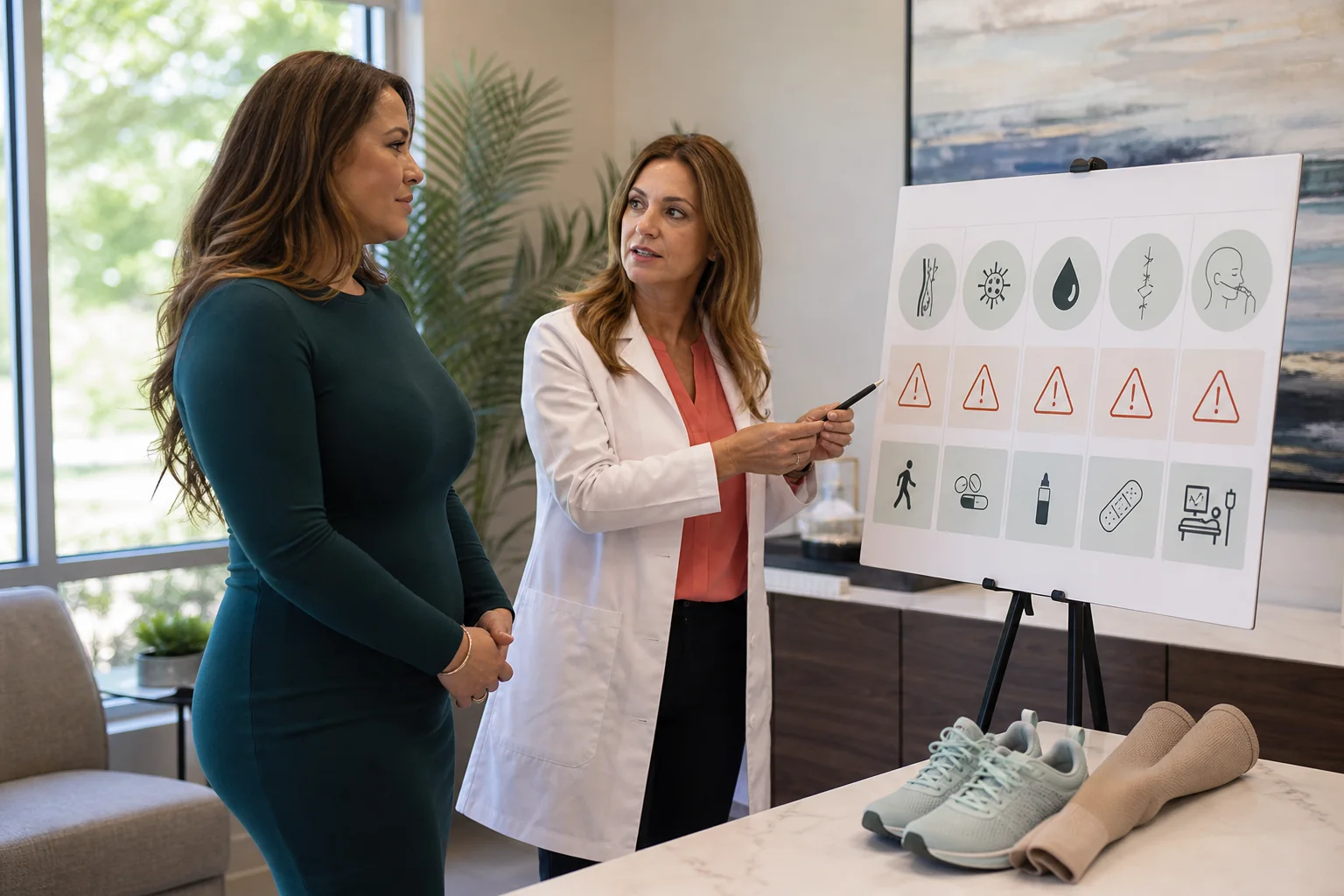
Every surgical procedure carries risks, and a mommy makeover combines multiple procedures under one anesthesia session — amplifying certain risks. This page covers every significant complication with published rates where available. Most complications are minor and manageable. A few are serious and potentially life-threatening. Understanding them is essential to informed consent.
Complications at a Glance
| Complication | Approximate Rate | Severity |
|---|---|---|
| Seroma | 5–15% | Minor (usually) |
| Hematoma | 2–4% | Minor to moderate |
| Wound dehiscence | 1–3% | Moderate |
| Infection | 1–3% | Moderate |
| Asymmetry / contour irregularity | Variable | Minor to moderate |
| Hypertrophic / wide scarring | 5–15% | Minor (cosmetic) |
| Temporary numbness | Nearly universal | Minor (usually resolves) |
| Permanent sensory changes | 5–15% | Minor |
| VTE (DVT / PE) | 0.1–1% | Serious / life-threatening |
| Anesthesia complications | <0.5% | Serious |
| Fat necrosis | 1–5% | Minor to moderate |
| Skin necrosis / flap loss | <1% | Serious |
Rates are approximate and drawn from published abdominoplasty and breast surgery literature. According to Winocour et al., combined procedures may carry higher rates than single procedures.1 For an in-depth discussion of why combining increases risk, see combined-procedure risk.
Bleeding and Hematoma
A hematoma is a collection of blood beneath the skin. It occurs in approximately 2–4% of abdominoplasty patients and 1–3% of breast surgery patients, according to Winocour et al.1 Small hematomas may reabsorb on their own. Larger ones cause swelling, pain, and pressure, and require surgical drainage under local anesthesia.
Risk factors: uncontrolled blood pressure, aspirin or blood-thinning supplements (fish oil, vitamin E, garlic), strenuous activity too early in recovery, and genetics.
Prevention: stop all blood-thinning medications and supplements as instructed (usually 2 weeks before surgery), avoid strenuous activity for 4–6 weeks, and report any sudden increase in swelling or bruising to your surgeon immediately.
Seroma
A seroma is a pocket of clear fluid that collects beneath the skin, particularly common after abdominoplasty (5–15%) as reported by Swanson.2 It occurs because the surgery separates tissue planes, creating space where fluid can accumulate.
Most seromas are drained in the office with a needle (aspiration) — a quick, minimally painful procedure that may need to be repeated several times. Wearing compression garments and limiting activity reduce seroma risk. Progressive tension suture techniques used by some surgeons also reduce seroma rates.
Infection
Surgical site infection occurs in 1–3% of mommy makeover patients. Superficial infections present as redness, warmth, swelling, and discharge around the incision and typically respond to oral antibiotics. Deep infections are less common but more serious, potentially requiring IV antibiotics or surgical drainage.
Risk factors: diabetes, obesity (BMI >30), smoking, longer operative times, poor wound care, and immunosuppression.
Prevention: prophylactic antibiotics are given before and during surgery. Post-operative wound care instructions (keeping incisions clean and dry) are critical. Know the signs of infection and contact your surgeon promptly.
Wound Dehiscence
Wound dehiscence — partial or complete opening of the surgical incision — occurs in 1–3% of abdominoplasty patients. It is more common at the T-junction (where vertical and horizontal incisions meet) and in patients with tension on the closure, diabetes, or poor nutritional status.
Small areas of dehiscence are managed with wound care (wet-to-dry dressings, negative pressure wound therapy) and heal by secondary intention. Larger openings may require surgical re-closure. The resulting scar is typically wider and may require revision later.
Scarring
All surgery produces scars. A mommy makeover involves incisions on the abdomen (hip-to-hip, usually along the bikini line) and the breasts (pattern depends on the procedure). Scars mature over 12–18 months, gradually fading from red/pink to a pale line.
Some patients develop hypertrophic scars (raised, thick, staying within incision boundaries) or, more rarely, keloids (raised scars that extend beyond incision lines). Risk factors include genetics (more common in darker skin), tension on the wound, and infection. For scar management strategies, see our scar healing guide.
Nerve Damage and Numbness
Temporary numbness of the abdominal skin after abdominoplasty is nearly universal. The surgery necessarily cuts small sensory nerves in the abdominal flap. For most patients, sensation returns gradually over 6–18 months as nerves regenerate. Small areas of permanently reduced sensation — particularly between the navel and the incision — are common and generally not functionally significant.
Breast surgery can also affect nipple sensation. Depending on the procedure, temporary changes in nipple sensitivity occur in 10–30% of patients. Permanent loss of nipple sensation is less common (2–5%) but possible, particularly with more extensive lift techniques.
Venous Thromboembolism (VTE)
VTE — deep vein thrombosis (DVT) and pulmonary embolism (PE) — is the most dangerous complication of cosmetic surgery and the leading cause of death in this setting. According to Keyes et al., the rate in combined body contouring procedures is estimated at 0.1–1%, depending on patient risk factors and prophylaxis measures.3
This topic is covered in depth on our combined-procedure risk page. Key prevention measures include early walking after surgery, sequential compression devices during surgery, risk-appropriate pharmacological prophylaxis, and stopping estrogen-containing birth control before surgery.
Anesthesia Risks
General anesthesia carries risks separate from the surgical procedure, including allergic reactions, breathing complications, cardiac events, and rare conditions such as malignant hyperthermia. Individual risk varies with health, procedure complexity, and duration. The ASPS ambulatory-surgery safety advisory emphasizes appropriate patient selection, monitoring, procedure planning, and use of an accredited or licensed facility.4
Risk increases with longer anesthesia times, obesity, sleep apnea, and pre-existing cardiac or pulmonary conditions. A pre-operative anesthesia consultation identifies patients at higher risk.
Fat Necrosis and Skin Necrosis
Fat necrosis occurs when a small area of fatty tissue loses its blood supply and hardens into a firm, sometimes tender lump under the skin. It affects roughly 1–5% of patients, most often at the edges of a tummy tuck flap or within a fat-grafted breast. Most cases resolve on their own over several months or are managed by monitoring; larger or persistent areas are occasionally drained or excised if they do not soften.
Skin necrosis (loss of skin due to inadequate blood flow) is less common, affecting fewer than 1% of patients, but is more serious because dead skin must be surgically removed and the wound allowed to heal, sometimes leaving a wider scar. Smoking is the single largest modifiable risk factor for skin necrosis — nicotine constricts the small vessels that supply the healing flap. Surgeons routinely require smoking cessation for at least 4–6 weeks before and after surgery for this reason.
Who Is at Higher Risk
Complication rates are not evenly distributed. Certain factors, some modifiable and some not, shift an individual patient’s risk above or below the population averages listed on this page.
Modifiable risk factors (things you can change before surgery): active smoking or nicotine use, uncontrolled blood glucose in diabetic patients, obesity (BMI over 30), poorly controlled blood pressure, and use of blood-thinning supplements or medications close to surgery. Optimizing each of these before your procedure meaningfully lowers your individual risk.
Non-modifiable factors: age, genetic clotting disorders, prior history of VTE, keloid-prone skin, and the number of procedures combined in a single session. Patients with several non-modifiable risk factors may be better candidates for a staged approach — splitting the mommy makeover into two or more shorter surgeries — rather than one long combined session. Your surgeon and anesthesiologist should discuss this trade-off with you explicitly during consultation.
How Surgical Teams Minimize Risk
None of the complications above can be reduced to zero, but published safety data consistently point to a handful of practices that lower rates across the board:
- Board certification. Surgeons certified by a recognized board (such as the American Board of Plastic Surgery or an equivalent national body) have completed accredited training and are held to defined safety standards. See our guide to choosing a qualified surgeon.
- Accredited facilities. Hospitals or surgical centers accredited by bodies such as AAAASF or the Joint Commission maintain equipment, staffing, and emergency protocols that reduce anesthesia and infection risk.
- Limiting operative time. Because VTE and anesthesia risk both rise with time under anesthesia, many surgeons cap combined procedures at a set number of hours or split extensive cases into two stages. See why anesthesia time matters.
- Individualized VTE prophylaxis. Risk-scoring tools (such as the Caprini score) guide the use of compression devices, early ambulation, and, for higher-risk patients, blood-thinning medication around the time of surgery.
- Thorough pre-operative work-up. Medical clearance, medication review, and a dedicated anesthesia consultation catch problems — undiagnosed sleep apnea, uncontrolled hypertension — before they become intraoperative emergencies.
Asymmetry and Aesthetic Disappointment
Some degree of asymmetry is natural (no one is perfectly symmetrical before surgery), and perfect symmetry after surgery is impossible. Minor breast asymmetry in size, shape, or position is common. Abdominal contour irregularities, uneven belly button appearance, or visible scarring may also occur.
Managing expectations is a critical part of the pre-operative process. If you are dissatisfied with results, revision surgery may be an option — but it adds cost, recovery time, and its own risks. Clarify your surgeon’s revision policy before the primary surgery.
Frequently Asked Questions
-
The most common are seroma (5–15%), hematoma (2–4%), wound dehiscence (1–3%), infection (1–3%), and temporary numbness (nearly universal after abdominoplasty). Most are manageable with office-based treatment.
-
Surgical site infection occurs in approximately 1–3% of patients. Most are superficial and respond to oral antibiotics. Risk factors include diabetes, smoking, obesity, and longer operative times.
-
Temporary numbness is nearly universal. Sensation usually returns over 6–18 months. Small areas of permanently reduced sensation are common but generally not functionally significant.
-
Death is rare — approximately 1 in 50,000 to 1 in 100,000 procedures. Combined procedures carry higher risk. The leading cause is VTE. Read our combined-procedure risk page for complete information.
-
Stop smoking or nicotine use at least 4–6 weeks before and after surgery, control blood glucose and blood pressure, maintain a stable weight beforehand, stop blood-thinning supplements as instructed, and choose a board-certified surgeon operating in an accredited facility. Discuss whether a staged approach is safer for your individual risk profile.
Key Takeaways
- Most mommy makeover complications are minor and manageable (seroma, hematoma, wound healing issues).
- VTE is the most dangerous complication and the leading cause of death after cosmetic surgery.
- Temporary numbness after abdominoplasty is nearly universal; most sensation returns within 6–18 months.
- Infection risk is 1–3% and is increased by diabetes, smoking, and obesity.
- Combined procedures carry higher complication rates than single procedures.
- Understanding risks is not about fear — it’s about informed consent.
Sources
- Winocour J, Gupta V, Ramirez JR, et al. Abdominoplasty: Risk Factors, Complication Rates, and Safety of Combined Procedures. Plast Reconstr Surg. 2015;136(5):597e-606e.
- Swanson E. Prospective outcome study of 360 patients treated with liposuction, lipoabdominoplasty, and abdominoplasty. Plast Reconstr Surg. 2012;129(4):965-978.
- Keyes GR, Singer R, Iverson RE, et al. Mortality in outpatient surgery. Plast Reconstr Surg. 2008;122(1):245-250.
- American Society of Plastic Surgeons. Evidence-Based Patient Safety Advisory: Patient Selection and Procedures in Ambulatory Surgery. Plast Reconstr Surg. 2009;124(4S):6S–27S.