
When Surgery Isn’t the Answer: Non-Surgical Options After Pregnancy
Key Takeaway
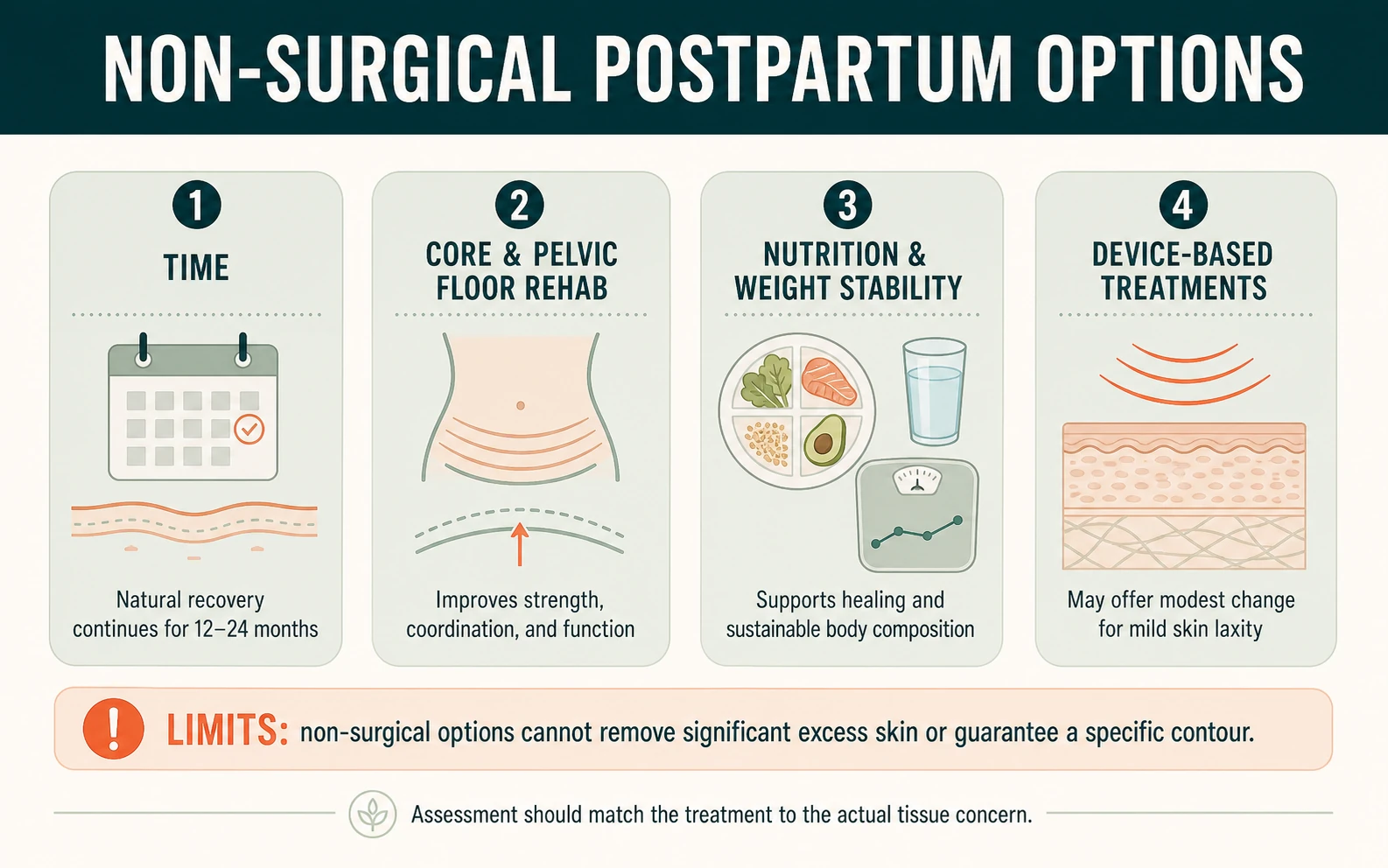
For most postpartum body changes, the first and most important step is time — followed by core and pelvic floor rehabilitation. Many women see meaningful improvement without surgery. This guide covers what works, what doesn’t, and how to know when you have genuinely explored your non-surgical options.
Time: The Most Underappreciated Option
This may sound unsatisfying, but it is the most evidence-based first “intervention” for postpartum body changes: give your body time to heal.
After pregnancy, the body undergoes a recovery process that continues for 12–24 months. During this time:
- Uterine involution is complete by 6 weeks — the uterus returns from approximately 1,000 grams to its pre-pregnancy size of about 70 grams, per the American College of Obstetricians and Gynecologists1
- Fluid redistribution occurs over 2–3 months as the body sheds the 40–50% increase in blood volume that pregnancy required
- Hormonal normalization takes months and is prolonged by breastfeeding
- Collagen remodeling in the skin and scar tissue continues for up to 2 years
- Diastasis recti shows the most spontaneous improvement in the first 8 weeks, with continued but slower recovery over 6–12 months, according to Sperstad et al.2
What you see at 3 months postpartum is a body still in active recovery. Many women make assessments and decisions at this stage that are premature. The body you have at 3 months is not the body you will have at 12 or 18 months.
This does not mean doing nothing. It means understanding that time itself is doing significant work, and that other interventions are most effective when layered on top of the body’s natural healing process.
Core and Pelvic Floor Rehabilitation
If there is one non-surgical intervention that the evidence most strongly supports for postpartum body changes, it is structured core and pelvic floor rehabilitation guided by a qualified physical therapist.
Why It Matters
The core is not just the “six-pack” muscles. It is a system: the diaphragm on top, the pelvic floor on the bottom, the transverse abdominis wrapping around the sides, and the multifidus in the back. During pregnancy, every component of this system is stretched, displaced, or weakened. Restoring their coordinated function is the foundation of postpartum recovery.
Core and pelvic floor dysfunction can manifest as:
- The persistent lower-belly bulge (“mom pooch”)
- Lower back pain
- Urinary leakage (stress incontinence)
- Pelvic pressure or heaviness
- Pain during intercourse
- Difficulty with balance and stability
A pelvic floor physical therapist can assess all of these and create a targeted plan.
What Rehabilitation Looks Like
Postpartum core rehabilitation is not intense gym work. It starts with retraining the foundations:
- Diaphragmatic breathing: relearning how to breathe so the diaphragm, pelvic floor, and transverse abdominis work together. This sounds simple but is often disrupted after pregnancy
- Transverse abdominis activation: gentle engagement of the deepest abdominal muscle, which provides the most support to the trunk
- Pelvic floor coordination: learning to both contract and relax the pelvic floor muscles — not just Kegels, but full coordination training
- Progressive loading: gradually increasing the demands on the core as the tissue strengthens and the coordination improves
This progression typically takes 3–6 months of consistent work. For women with diastasis recti, research shows that targeted exercise programs can reduce the inter-recti distance and improve abdominal wall function.3
Finding a Qualified Therapist
Look for a physical therapist who specializes in pelvic and postpartum health. APTA Pelvic Health maintains a public PT Locator for clinicians who report pelvic and abdominal health expertise; its listings are informational and are not independently credential-verified by APTA Pelvic Health.4 Ask about specific postpartum training, experience assessing diastasis recti, and whether the therapist evaluates the pelvic floor when clinically appropriate and with your consent.
Nutrition and Weight Stability
This section is intentionally not titled “Diet for Postpartum Weight Loss.” The goal is nutrition that supports healing, energy, and sustainable body composition — not restriction, punishment, or rapid weight loss.
What Supports Recovery
- Adequate protein: protein provides the building blocks for tissue repair, muscle maintenance, and collagen synthesis. Postpartum women (especially those breastfeeding) need more protein than non-pregnant women — approximately 1.1–1.5 g per kilogram of body weight per day
- Micronutrients for healing: vitamin C (collagen synthesis), zinc (wound healing), iron (replenishing stores after blood loss), and calcium (bone health, especially during breastfeeding)
- Adequate calories: breastfeeding requires approximately 450–500 additional calories per day. Severe caloric restriction during lactation can reduce milk supply, compromise nutrient quality, and slow recovery, per ACOG guidance1
- Hydration: adequate fluid intake supports skin health, milk production, and overall cellular function
What Does Not Help
- Extreme caloric restriction: crash diets slow metabolism, promote muscle loss over fat loss, and can trigger hormonal dysfunction
- Elimination diets without medical reason: cutting out entire food groups (dairy, grains, etc.) without a diagnosed intolerance provides no benefit and may create nutritional gaps
- “Detox” diets: the body has a liver and kidneys. Commercial detox programs have no scientific basis and often promote laxative-induced water loss disguised as fat loss
- Supplements marketed for “postpartum belly”: no supplement targets abdominal fat. Products making these claims are not supported by evidence
Skin-Tightening Devices: An Honest Assessment
Non-invasive skin-tightening devices are a growing market. Here is what the evidence currently supports for postpartum use:
Radiofrequency (RF)
RF devices deliver controlled heat to the dermis, causing collagen contraction and stimulating new collagen production over the following months. Clinical studies show measurable skin tightening in some patients, but the degree is typically described as mild to moderate, according to published RF device research.5
Best for: mild skin laxity with good underlying skin quality. Not effective for: moderate to severe laxity with redundant skin folds.
RF treatments typically require multiple sessions (3–6), with results developing over 3–6 months after the final session. Cost varies significantly by provider and geographic area.
Focused Ultrasound
Microfocused ultrasound targets deeper tissue layers. It has FDA clearance for facial and neck lifting. Use on the abdomen is off-label, and evidence is limited. Results, when achieved, are subtle.
Cryolipolysis (Fat Freezing)
Cryolipolysis targets and reduces subcutaneous fat cells through controlled cooling. It does not tighten skin. It can be effective for localized fat pockets that do not respond to weight management, but it requires appropriate patient selection. It is not a solution for loose skin or diastasis recti.
Laser Treatments
Fractional lasers (both ablative and non-ablative) can stimulate collagen remodeling and improve skin texture and mild laxity. They may also improve the appearance of stretch marks. However, results for significant abdominal skin laxity are limited.
The Bottom Line on Devices
Non-invasive devices can produce real but modest improvements for mild changes. They are not substitutes for surgical excision when significant excess tissue is present. They work best when expectations are calibrated appropriately: think “improvement” rather than “transformation.”
What Doesn’t Work: Myths and Marketed Products
Spot Reduction
The idea that specific exercises can remove fat from a targeted body area has been thoroughly debunked. A 2013 study demonstrated that localized muscle endurance training did not preferentially reduce fat in the trained area.6 You cannot crunch, plank, or leg-raise your way to a flat lower abdomen if subcutaneous fat is the issue. Fat loss occurs systemically, determined by overall energy balance and genetics.
Waist Trainers and Belly Wraps
There is no scientific evidence that external compression permanently reshapes the body. Waist trainers may provide temporary visual changes (compression moves tissue while being worn) and some postural support, but they do not reduce fat, tighten skin, or repair diastasis recti.
Potential concerns with prolonged use include weakening of the core muscles (the external support reduces the need for the muscles to engage), increased intra-abdominal pressure (which can worsen pelvic floor dysfunction), and skin irritation.
Detox Products, Wraps, and Teas
Products marketed as “postpartum detox” — including body wraps, herbal teas, and juice cleanses — do not work. Any weight loss from these products is water loss that returns within hours or days. They have no effect on fat, skin laxity, or muscle separation. Some of these products contain ingredients that are contraindicated during breastfeeding.
Supplements Marketed for Belly Reduction
No supplement — including collagen peptides, CLA, green tea extract, or any proprietary blend — has been shown to specifically target postpartum abdominal changes. While collagen peptides have some early evidence for general skin health, the effect on significant postpartum skin laxity is not established.
When to See a Specialist
A pelvic floor physical therapist should be the first specialist for most postpartum body concerns. Consider a referral when:
- You suspect diastasis recti (bulging or doming of the midline when straining)
- You have urinary leakage, pelvic pressure, or pain during intercourse
- You have persistent lower back pain that has not responded to general exercise
- You want to return to exercise but are not sure what is safe
- You had a cesarean delivery and want scar mobilization guidance
For persistent skin concerns that do not respond to time and non-invasive approaches, a board-certified dermatologist can assess skin quality and discuss device-based options.
When Surgery Is Actually Needed
This guide is about non-surgical options, but it would be incomplete — and dishonest — without acknowledging that surgery is sometimes the right answer.
Surgery may be the more appropriate option when:
- Significant excess skin: moderate to severe skin laxity with redundant folds that cause skin-on-skin irritation, hygiene difficulties, or interference with clothing and movement. No non-surgical approach can remove this tissue
- Severe diastasis recti: a large separation (typically greater than 3 cm) that has not improved with 6 or more months of targeted rehabilitation. Surgical plication (suturing the muscles together) is the definitive repair
- Physical symptoms: chronic back pain related to abdominal wall weakness, recurrent skin infections in abdominal folds, or functional limitations that non-surgical approaches have not resolved
- Quality of life: when the body changes meaningfully impact a woman’s daily comfort, clothing choices, physical activity, or psychological well-being — and non-surgical approaches have been given adequate time
Choosing surgery after genuinely exploring non-surgical options is not a failure. It is a well-informed decision. The key is that “genuinely exploring” means more than a few weeks — it typically means 12–18 months of time, rehabilitation, and honest assessment.
Key Facts
- The body continues healing for 12–24 months postpartum — time is the first intervention
- Core and pelvic floor rehabilitation is the most evidence-supported non-surgical approach
- Breastfeeding requires ~450–500 additional calories per day — extreme restriction is harmful
- Skin-tightening devices produce modest results for mild laxity only
- Spot reduction, waist trainers, and detox products do not work
- Surgery is a legitimate option when non-surgical approaches have been genuinely explored
Frequently Asked Questions
What non-surgical options actually work for postpartum body changes?
The most evidence-supported non-surgical approaches are core and pelvic floor rehabilitation (especially for diastasis recti and core weakness), time (the body continues healing for 12–24 months), nutrition and weight stability, and scar mobilization after cesarean delivery. Skin-tightening devices like radiofrequency can produce modest results for mild skin laxity. No topical product, supplement, or waist trainer has strong evidence for postpartum body changes.
How long should I try non-surgical options before considering surgery?
Most medical professionals recommend giving non-surgical approaches at least 12–18 months. This allows the body to complete its natural healing process and gives interventions like core rehabilitation adequate time to show results. Surgery is generally not recommended until weight is stable, family planning is complete, and non-surgical options have been genuinely explored.
Do postpartum belly wraps or waist trainers work?
There is no scientific evidence that belly wraps or waist trainers permanently reshape the postpartum body. They may provide temporary compression and postural support, which some women find comfortable in the early postpartum weeks. However, they do not reduce fat, tighten skin, or close diastasis recti. Prolonged use of overly tight garments may actually weaken core muscles and worsen pelvic floor dysfunction.
Can I do pelvic floor physical therapy while breastfeeding?
Yes. Pelvic floor physical therapy is safe and appropriate during breastfeeding. In fact, the postpartum period — including while breastfeeding — is an ideal time to begin core and pelvic floor rehabilitation. The hormonal environment during breastfeeding (specifically lower estrogen levels) can affect tissue laxity, which makes targeted rehabilitation even more important during this time.
When is surgery actually needed instead of non-surgical options?
Surgery may be the more appropriate option when there is significant excess skin that cannot retract (moderate to severe skin laxity with redundant folds), severe diastasis recti that has not responded to 6 or more months of targeted rehabilitation, or when postpartum body changes cause physical symptoms like chronic skin irritation, hygiene difficulties, or back pain that does not respond to conservative treatment. Surgery is a legitimate choice — not a failure of non-surgical effort.
Key Takeaways
- Time is the first and most important non-surgical intervention — the body heals for 12–24 months postpartum
- Core and pelvic floor rehabilitation with a qualified therapist is the most impactful step you can take
- Nutrition should support healing and energy, not punishment or extreme restriction
- Skin-tightening devices have a role for mild laxity but cannot replace surgical excision for significant excess skin
- Spot reduction, waist trainers, detox products, and belly-reduction supplements do not work
- Surgery is a valid and sometimes necessary option — the key is genuine exploration of non-surgical approaches first
Sources
- American College of Obstetricians and Gynecologists. Physical Activity and Exercise During Pregnancy and the Postpartum Period. ACOG Committee Opinion No. 804. 2020.
- Sperstad JB, Tennfjord MK, Hilde G, et al. Diastasis recti abdominis during pregnancy and 12 months after childbirth: prevalence, risk factors and report of lumbopelvic pain. Br J Sports Med. 2016;50(17):1092-6.
- Benjamin DR, van de Water AT, Peiris CL. Effects of exercise on diastasis of the rectus abdominis muscle in the antenatal and postnatal periods: a systematic review. Physiotherapy. 2014;100(1):1-8.
- Academy of Pelvic Health Physical Therapy (APTA Pelvic Health). Pelvic Health Physical Therapy Near You: PT Locator. Accessed 2026.
- Brightman L, Goldman MP, Taub AF. Sublative rejuvenation: experience with a new fractional radiofrequency system for skin rejuvenation and repair. J Drugs Dermatol. 2009;8(11 Suppl):s9-13.
- Ramírez-Campillo R, Andrade DC, Campos-Jara C, et al. Regional fat changes induced by localized muscle endurance resistance training. J Strength Cond Res. 2013;27(8):2219-24.