
What Is a Mommy Makeover? Procedures, Combinations & What to Expect
- A mommy makeover is not a single operation — it’s a custom combination of procedures tailored to each patient’s anatomy and goals.
- The most common combination is abdominoplasty (tummy tuck) plus a breast procedure (lift, augmentation, or both), often with liposuction.
- Combining procedures means one anesthesia session and one recovery period — but longer operating time increases certain risks.
- It is body contouring, not weight loss, and it does not fix problems unrelated to pregnancy-driven skin, muscle, or breast changes.
- Ideal candidates are done having children, at a stable weight, and in good overall health.
- US costs typically range from $12,000 to $25,000+ depending on the combination.5
A mommy makeover is the term surgeons use for a customized set of body-contouring procedures — usually a tummy tuck combined with breast surgery, and often liposuction — performed together to reverse the physical changes pregnancy and breastfeeding leave on the abdomen, breasts, and midsection. It is not a brand name for one operation; it is a planning approach. This page walks through what the term actually covers, what it does and doesn’t do, how the timing and combination decisions get made, and where to go for the deeper detail on each part.
A Mommy Makeover Is Not One Operation
The single biggest misconception about the term is that it refers to a fixed surgical package with a set price and a set procedure list. It doesn’t. There is no professional or regulatory definition that specifies exactly which procedures qualify. It is simply a combination of two or more body-contouring surgeries — most often abdominal, breast, and sometimes contouring work — performed in a single operative session so a patient recovers once instead of two or three separate times.
Because there is no standard package, no two combinations look the same on paper. One woman may need only a tummy tuck and a breast lift. Another may combine muscle repair, implants, and flank liposuction. A third may skip the abdominal component entirely and focus only on breast restoration. Every combination is built around what pregnancy actually changed in that individual body, which is why the planning conversation with a board-certified plastic surgeon matters more than the marketing term itself.
What It Typically Includes
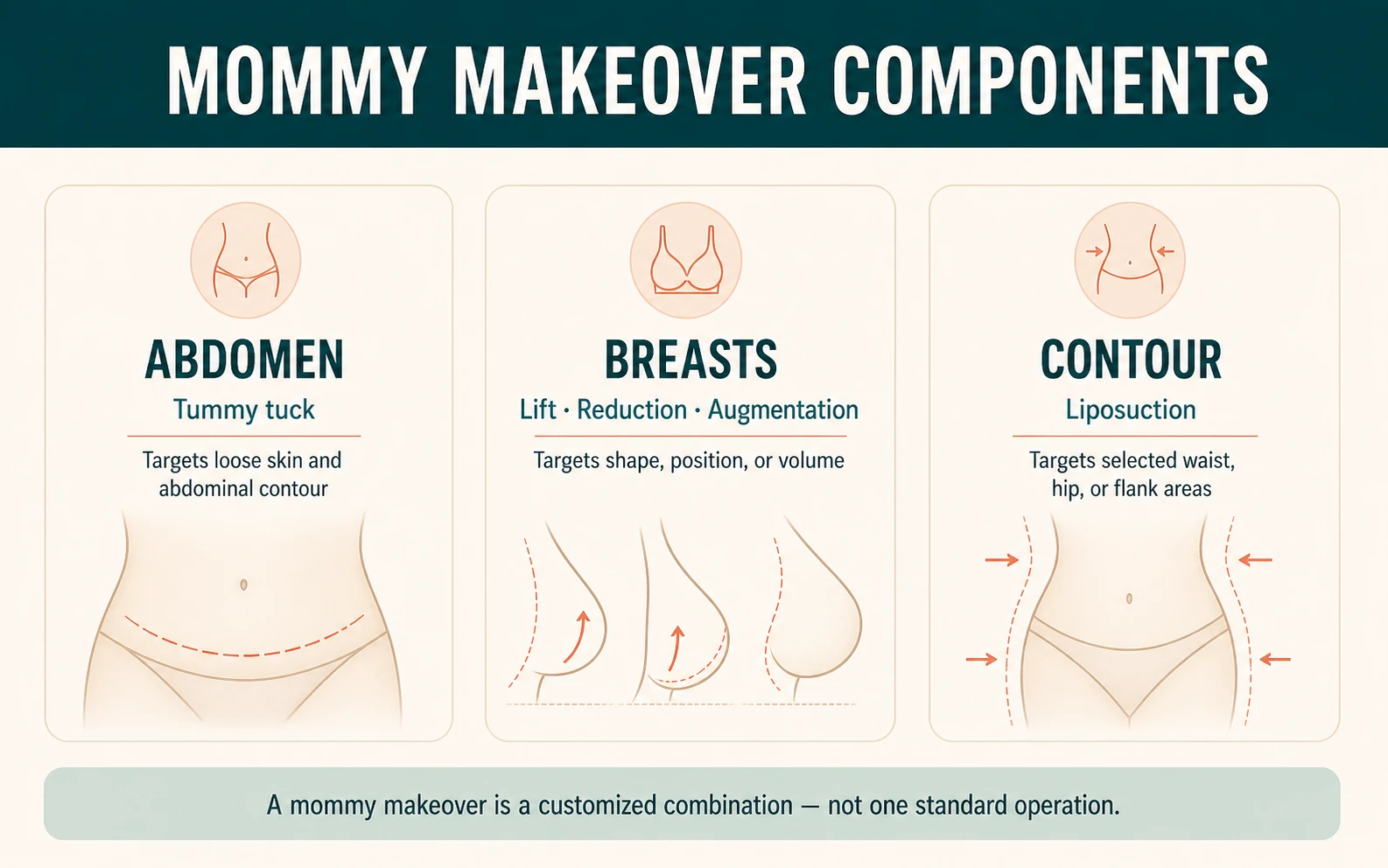
Most mommy makeover plans draw from three categories of procedures. A given patient may need one, two, or all three — the categories below describe what each typically addresses, not a checklist every patient must complete.
Abdominal Component
For most women, the abdomen changes the most after pregnancy: stretched skin that doesn’t fully retract, and separation of the rectus muscles down the midline, known as diastasis recti. Research following postpartum women found diastasis recti present in roughly a third to two-thirds of patients at various points after delivery, depending on how long after birth they were assessed.2 A tummy tuck (abdominoplasty) removes the excess skin and surgically closes that muscle gap — something exercise cannot do on its own. This is usually the most involved single component of the combination, and it is the one that most affects total operating time. The full mechanics of the abdominal component, including muscle repair techniques and scar placement, are covered in depth on our full component breakdown page — this overview intentionally keeps things brief so it doesn’t duplicate that page.
Breast Component
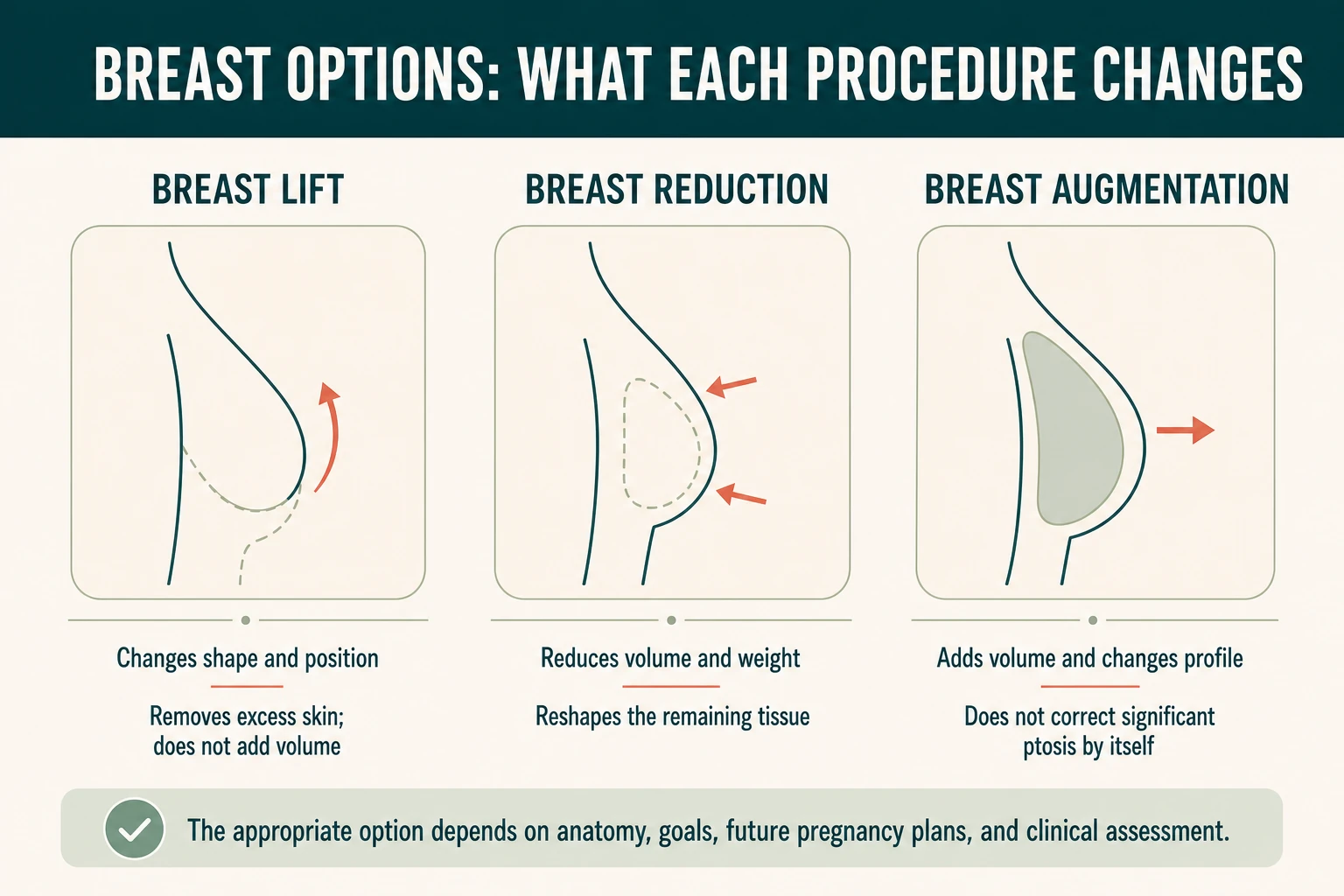
Pregnancy and breastfeeding change breast volume and skin elasticity, which can leave breasts looking deflated, uneven, or lower than before. The breast component may be a lift alone (mastopexy) to reposition tissue without adding volume, implants alone if volume loss is the main concern, or a lift-plus-implant combination. Interestingly, research specifically looking at breastfeeding history found it was not a significant independent risk factor for breast ptosis — age, BMI, number of pregnancies, and smoking were the stronger predictors.4 That is useful context if you have been told breastfeeding is "why" your breasts changed; the fuller picture, and how to choose between lift, implants, or reduction, is covered on our breast options page.
Contouring Component
Liposuction is the most common add-on, used to refine areas that resist diet and exercise — typically the flanks, bra line, inner thighs, or upper arms. When performed together with a tummy tuck, liposuction adds contouring precision without a separate recovery period, though a nationwide safety analysis of liposuction combinations found that adding procedures does increase the overall complication rate compared with a single, isolated operation.6 Some patients also add fat transfer to the buttocks (BBL) using the liposuction harvest; because that specific pairing carries its own recovery and positioning considerations, we cover it separately on our BBL combination page rather than folding it into this overview.
What It Doesn’t Do
This is body contouring, not a weight-loss method. It removes excess skin and repairs separated muscle and lax tissue — things diet and exercise cannot reverse — but it does not replace healthy eating, physical activity, or medical treatment for obesity, and most surgeons want patients at a stable weight for at least three to six months before proceeding, precisely because significant weight change afterward can undo the result.
It also has boundaries beyond weight. It does not treat pelvic floor dysfunction, urinary incontinence, or prolapse — those are gynecological or physical-therapy concerns, not plastic surgery ones. It does not address every abdominal complaint either: the abdominal component here is specifically built around diastasis recti and skin excess, not general core weakness or unrelated hernias, which need their own evaluation. And it does not resolve postpartum hormonal shifts or the mental-health dimension of body image — those benefit from their own dedicated care, alongside realistic expectations about what surgery alone can change.
Choosing Your Combination
Because there is no fixed package, the real decision isn’t "should I get a mommy makeover" — it’s "which combination fits my body and my priorities." Surgeons typically build a plan around three inputs: a physical exam of skin laxity, muscle separation, and breast changes; the patient’s own goals and tolerance for scarring or downtime; and overall health factors like BMI and smoking status that affect what can be safely combined in one session.
The most popular pairings, why surgeons recommend them, and how to think through your own combination — including when it makes sense to add liposuction or a BBL, and when it doesn’t — are covered in detail on our popular combinations guide. That page is the right next stop if you already know you want more than just one procedure but aren’t sure which pairing suits you.
All at Once vs. Staged: Which Approach Fits You?
Combining procedures into a single session saves one anesthesia exposure and one recovery period, but it isn’t automatically the safer or better choice for every patient. When the expected operation would be lengthy or the patient has additional risk factors, the surgeon may recommend staging. A multicenter retrospective study found higher complication rates with combined aesthetic procedures and emphasized careful patient selection and risk assessment; the interval between stages is individualized.3
Staging trades one longer recovery for two shorter ones, and it can also let a surgeon see how the abdominal result settles before finalizing the breast plan. It is not automatically the "safe" choice or the "conservative" choice — it is a trade-off that depends on your anatomy, your health profile, and how much combined operating time your surgeon and anesthesia team are comfortable with. Our staged vs. single session guide walks through exactly how that decision gets made.
Am I a Candidate? Timing Rules
Beyond general health, three timing rules govern candidacy specifically. First, most surgeons want patients done having children, since a future pregnancy can stretch repaired muscle and skin and reverse the abdominal result. Second, patients should be finished breastfeeding for several months so breast tissue has settled into its final post-nursing shape before a surgeon operates on it. Third, weight should be stable — not necessarily "ideal," but not fluctuating — for at least a few months, because operating on a moving target produces unpredictable results.
Health factors layer on top of timing: BMI, smoking status, and any uncontrolled medical conditions all affect what can be safely combined in one session versus what should be staged or limited. The full breakdown of postpartum timing windows (including how caesarean recovery differs from vaginal delivery), BMI thresholds, and practical readiness like arranging childcare during recovery, lives on our candidacy and timing page.
How Long Is Surgery? Why Duration Matters for Risk
Operating time is one factor in complication risk, but procedure type and patient factors also matter. A multicenter analysis of 670 patients reported higher complication rates among combined procedures than single procedures (49.1% vs. 26.3% in that study’s comparison) and specifically found higher risk when abdominoplasty was paired with liposuction or breast surgery.3 Those figures describe one retrospective dataset and are not an individual patient’s predicted risk.
This is exactly why duration isn’t just a scheduling detail — it is a safety variable that should factor into whether procedures are combined or staged, how long you’re under anesthesia, and your risk of complications like blood clots. Our safety guide covers venous thromboembolism (VTE) risk, anesthesia duration limits, and the questions worth asking a surgeon about how they manage long combined cases.
How Much Does a Mommy Makeover Cost?
Because this is a combination rather than a fixed procedure, there is no single price — the total depends entirely on which components are included. In the US, average surgeon fees run around $6,500 for abdominoplasty, $4,500 for breast augmentation, $5,500 for a breast lift, and $4,000 for liposuction, according to national statistics from the American Society of Plastic Surgeons; combined into a full package, that typically totals $12,000 to $25,000 or more once facility and anesthesia fees are included.5
Geography changes that total substantially, which is a major reason some patients look outside their home country for comparable combinations at a lower total price. The combination-by-combination US breakdown is on how much a mommy makeover costs. The cost hub covers packages, financing, insurance, and the US vs. Turkey comparison.
Frequently Asked Questions
A mommy makeover is not a single operation but a customized combination of body-contouring procedures — most often a tummy tuck plus a breast procedure, sometimes with liposuction — performed in one surgical session to address the physical changes pregnancy and breastfeeding leave behind.
Most combinations include an abdominal component (tummy tuck, sometimes with muscle repair), a breast component (lift, implants, or both), and often liposuction for stubborn areas like the flanks or thighs. The exact mix is customized to each patient’s anatomy and goals.
It is several procedures combined into a single anesthesia session and a single recovery period, rather than one standardized operation. That is why there is no fixed price or fixed procedure list — every combination is planned individually.
No. A tummy tuck (abdominoplasty) is one possible component of the combination, and it’s the most common one, but a mommy makeover typically also includes a breast procedure and sometimes liposuction. A woman can have a tummy tuck alone without it being labeled that way.
No. This is body contouring, not a weight-loss procedure. It removes excess skin and repairs stretched muscle and tissue that diet and exercise cannot fix, but it is not a substitute for reaching a stable, healthy weight first.
A tummy tuck plus breast procedure typically takes three to six hours depending on the combination and technique. Adding liposuction or a BBL extends operating time further, which is why many surgeons cap same-day combinations around six hours for safety.
In the US, a combined package typically runs $12,000 to $25,000 or more depending on the combination and surgeon fees. Costs vary by geography, facility fees, anesthesia, and which procedures are combined.
Key Takeaways
- A mommy makeover is a customized combination of procedures, not a single standardized operation with a fixed price.
- The abdominal, breast, and contouring components each address a different postpartum change — most patients need some, not all, of them.
- It is body contouring, not weight loss, and it doesn’t treat pelvic floor issues, hormonal changes, or non-diastasis abdominal complaints.
- Combined operating time is a real safety variable — longer sessions carry higher complication rates, which is why staging is sometimes recommended.
- Candidacy depends on being done having children, finished breastfeeding, and at a stable weight, not just on wanting the results.
- Total cost depends entirely on which components are combined; there is no single "mommy makeover price."
Sources
- Sperstad JB, Tennfjord MK, Hilde G, et al. Diastasis recti abdominis during pregnancy and 12 months after childbirth: prevalence, risk factors and report of lumbopelvic pain. Br J Sports Med. 2016;50(17):1092-6.
- Neel OF, Al-Khafaji MQM, Alrashoud NM, et al. Safety and Outcomes of Combined Aesthetic Surgical Procedures: A Retrospective Study of Risk Factors, Complication Rates, and Outcomes. Aesthetic Plast Surg. 2026;50(3):1190-1198.
- Rinker B, Veneracion M, Walsh CP. The effect of breastfeeding on breast aesthetics. Aesthet Surg J. 2008;28(5):534-7.
- American Society of Plastic Surgeons. 2024 Plastic Surgery Statistics Report. ASPS. 2024.
- Saad M, Chaker SC, James AJ, et al. A Nationwide Analysis of Complications and Risks Associated With Types of Liposuction in 69,424 Patients. Aesthet Surg J. 2025;45(12):1252-1262.
Go Deeper: Explore Each Component

What It Includes
A detailed breakdown of every procedure that can be part of a mommy makeover and how they work together.
Popular Combinations
The most common procedure pairings, why they work, and how to think about your own combination.
Breast Options
Lift, implants, reduction, or a combination — how to choose the right breast procedure for your makeover.

Mommy Makeover With BBL
Adding a Brazilian Butt Lift to your makeover — realistic expectations, safety concerns, and recovery impact.

Staged vs. Single Session
When combining everything makes sense and when splitting into two sessions is the safer choice.

Are You a Candidate?
Health requirements, timing after pregnancy, weight stability, and other factors that affect eligibility.