
The “Mom Pooch”: What It Is, What Causes It, and What Helps
Key Takeaway
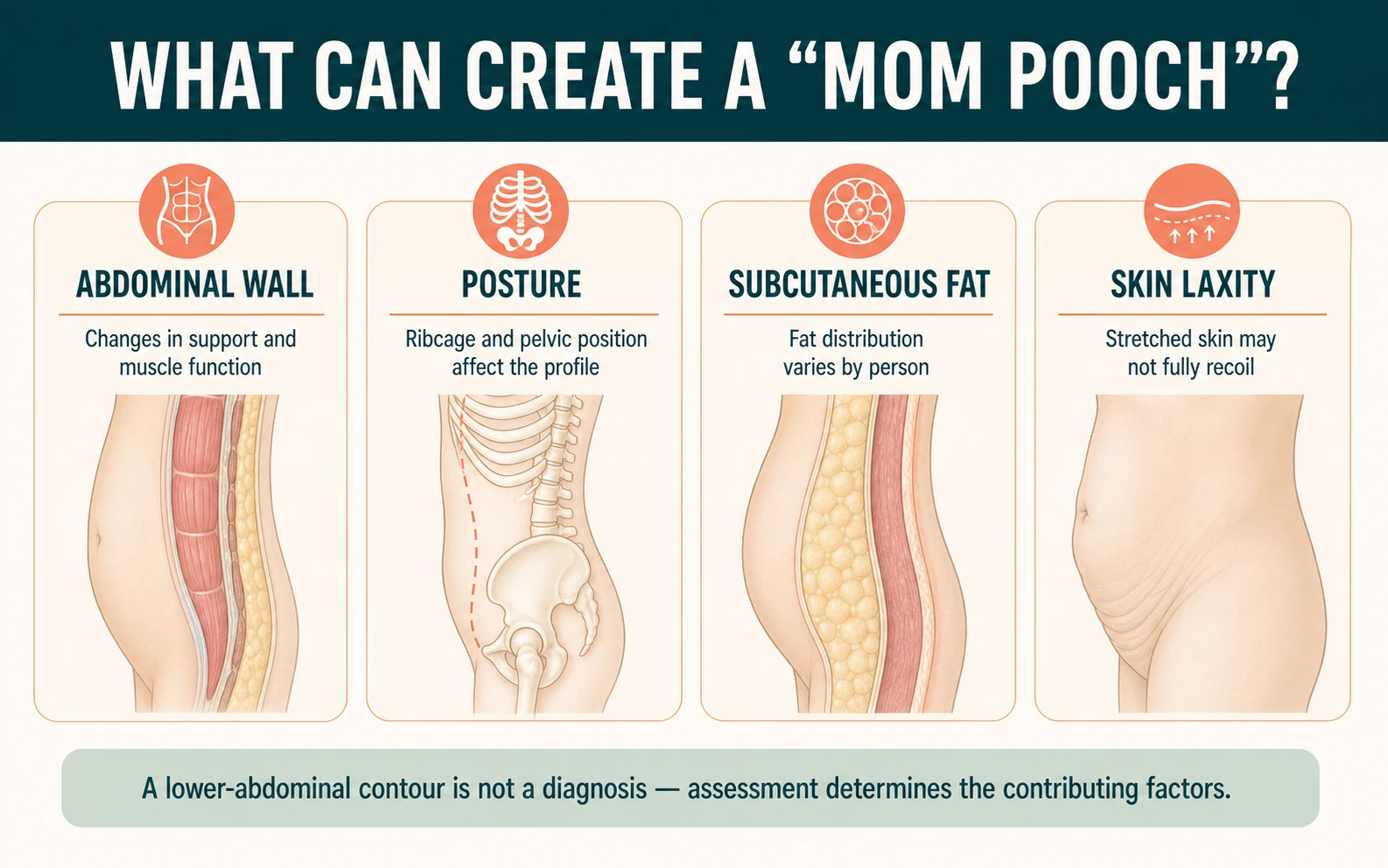
The “mom pooch” is not one thing — it can be skin laxity, subcutaneous fat, diastasis recti, or a combination. Identifying which factor is the primary driver in your case matters, because the effective approach is different for each one. Most women benefit from starting with core rehabilitation and giving the body adequate time before considering other options.
What People Mean by “Mom Pooch”
The “mom pooch” is a colloquial term — not a medical diagnosis. It describes the persistent lower abdominal fullness or bulge that many women notice after pregnancy, particularly when the upper abdomen has flattened but the area below the navel remains rounded or protruding.
It affects women after both vaginal and cesarean deliveries. It can appear immediately postpartum and persist long after the uterus has returned to its pre-pregnancy size. And it is one of the most common body-related concerns among new mothers.
Understanding what is actually causing the pooch in your specific case is important, because the term covers several distinct physical conditions, each with different timelines and different solutions.
The Three Primary Causes
The mom pooch is almost always caused by one or more of three factors. Many women have a combination.
1. Skin Laxity
Pregnancy stretches the abdominal skin significantly. After delivery, the skin may not fully retract — especially if the stretching exceeded the skin’s elastic capacity (which is influenced by genetics, age, and the degree of stretching). The result is soft, loose skin in the lower abdomen that can fold or bulge, particularly when sitting.
Skin laxity is more pronounced after multiple pregnancies, pregnancies with large babies or multiples, and in women with extensive stretch marks (which indicate structural damage to the dermal collagen and elastin fibers), as noted in a British Journal of Dermatology review.1
For more on this topic, see our loose skin after pregnancy guide.
2. Subcutaneous Fat
The lower abdomen is a common site for fat storage, and pregnancy hormones can shift fat distribution toward this area. Some amount of subcutaneous fat in the lower abdomen is normal and healthy. However, if the amount has increased beyond pre-pregnancy levels, it contributes to the pooch appearance.
It is important to distinguish between subcutaneous fat (which lies between the skin and the abdominal muscles) and visceral fat (which surrounds the organs inside the abdominal cavity). The pooch is almost always subcutaneous fat — the pinchable, soft layer that sits on top of the muscle wall.
3. Diastasis Recti (Abdominal Muscle Separation)
During pregnancy, the growing uterus pushes the two halves of the rectus abdominis muscle apart along the linea alba (the connective tissue strip running down the midline of the abdomen). This separation, called diastasis recti, affects an estimated 33–60% of postpartum women.2
When the muscles are separated, the abdominal wall cannot provide the same containment it normally would. This allows the organs and tissue behind the wall to push forward, creating a bulge — often most visible in the lower abdomen. The pooch from diastasis recti is typically more pronounced when straining (like sitting up from lying down) and may present as a visible ridge or dome along the midline.
After Cesarean: The Additional Factor
Women who have had cesarean deliveries may have an additional contributing factor: scar adhesion. The cesarean scar can adhere to the underlying fascia, creating a tethered indentation that makes the tissue above it bulge forward. This is commonly called the c-section shelf and can compound the mom pooch appearance.
How to Tell Which You Have
While a pelvic floor physical therapist can provide the most accurate assessment, here are some self-evaluation techniques:
Testing for Skin Laxity
Pinch the skin on your lower abdomen between your thumb and forefinger. If you can pinch a thin fold of skin that feels soft and papery (without much substance beneath it), skin laxity is a significant factor. If the pinch feels thick and substantial, there is likely subcutaneous fat beneath the skin as well.
Assessing Fat vs. Other Factors
If the lower abdomen feels soft and squishy when relaxed, and the pooch looks the same whether you are lying down or standing, subcutaneous fat is likely a primary contributor. If the pooch is less visible when lying flat and more prominent when standing or sitting up, muscular factors (like diastasis recti) are more likely playing a role.
Checking for Diastasis Recti
Lie on your back with knees bent and feet flat. Place 2–3 fingers horizontally just above your navel. Slowly lift your head and shoulders off the floor (a small crunch motion). Feel for a gap between the two sides of the rectus abdominis muscle. A gap wider than approximately 2 finger-widths (about 2 cm) suggests diastasis recti, per Sperstad et al. Also check below the navel, as the separation can occur at different points along the midline.2
Note: depth matters as much as width. Even a narrow separation that is very deep (meaning the fingers sink in significantly) can indicate compromised abdominal wall function.
What Helps Without Surgery
Core Rehabilitation (Most Important First Step)
Regardless of the primary cause of your mom pooch, core rehabilitation is the recommended starting point. A pelvic floor physical therapist can:
- Assess for diastasis recti and measure its width and depth
- Evaluate pelvic floor function (which is closely linked to core strength)
- Design a progressive exercise program that addresses your specific situation
- Teach you which exercises to avoid (like traditional crunches and sit-ups, which can worsen diastasis)
Effective core rehabilitation typically starts with deep stabilization exercises: diaphragmatic breathing, transverse abdominis activation, and coordinated pelvic floor engagement. These may not feel like “real” exercise, but they rebuild the foundation that everything else depends on, as supported by research on exercise and diastasis recti.3
For women with mild to moderate diastasis recti, consistent core rehabilitation over 3–6 months can significantly reduce the gap and improve the abdominal wall’s ability to support the trunk — which directly reduces the pooch.
Gradual Weight Management
If subcutaneous fat is a contributing factor, gradual and sustainable weight management can help. Key principles:
- No crash diets: extreme caloric restriction is counterproductive. It can slow metabolism, compromise milk supply if breastfeeding, and lead to muscle loss rather than fat loss
- No spot reduction: there is no exercise or diet that targets lower-abdominal fat specifically. Fat loss occurs throughout the body based on genetics and hormones, not targeted exercises, as controlled studies confirm4
- Nutrient-dense eating: prioritize adequate protein (which supports tissue repair and muscle maintenance), whole foods, and consistent energy intake
- Patience: healthy postpartum weight loss typically occurs at 0.5–1 pound per week. Faster rates risk muscle loss and hormonal disruption
Scar Mobilization (After Cesarean)
If you had a cesarean delivery and suspect scar adhesion is contributing to your pooch, scar mobilization can help release the tethering. See our c-section shelf guide for detailed techniques.
Time
The body continues healing and remodeling tissue for 12–24 months after pregnancy. Hormonal changes, fluid shifts, and scar maturation all contribute to ongoing changes in appearance. What you see at 3 months is not what you will see at 12 months.
What Won’t Work
- Crunches and sit-ups alone: if diastasis recti is present, these exercises can widen the separation and worsen the pooch. Even without diastasis, they do not target the deeper core muscles that provide real support
- Waist trainers and corsets: no evidence supports permanent body reshaping from compression garments. They may provide temporary visual changes but do not address underlying causes
- Spot-reduction exercises: 1,000 leg raises will not eliminate lower-abdominal fat. This is a persistent myth with no scientific basis
- “Detox” products: teas, wraps, and cleanses marketed for postpartum belly reduction do not work. They may cause temporary water loss that returns immediately
- Skin-firming creams: no topical product can tighten loose skin or reduce fat. Moisturizing is fine for skin health; expecting structural change is not realistic
When Surgery Addresses the Mom Pooch
For some women, the mom pooch persists after adequate time, core rehabilitation, and weight stability. In these cases, surgery may address what non-surgical approaches cannot:
- Abdominoplasty can remove excess skin, reduce subcutaneous fat, and repair diastasis recti in a single procedure
- Liposuction can reduce subcutaneous fat but does not address skin laxity or diastasis
- Mini abdominoplasty addresses the lower abdomen only (below the navel) and is appropriate when the upper abdomen is in good condition
The decision to pursue surgery is personal. It should be made after non-surgical options have been given a genuine effort (typically 12–18 months), family planning is complete, and weight is stable. The American Society of Plastic Surgeons provides detailed information about candidacy and expected outcomes.5
For a thorough discussion of non-surgical approaches, see our non-surgical postpartum options guide.
Key Facts
- The “mom pooch” can be caused by skin laxity, subcutaneous fat, diastasis recti, or a combination
- Diastasis recti affects 33–60% of postpartum women and can be assessed with a simple self-check
- Core rehabilitation with a pelvic floor physical therapist is the recommended first step
- Spot reduction does not work — no exercise targets lower-abdominal fat specifically
- Traditional crunches can worsen diastasis recti
- Surgery addresses what non-surgical approaches cannot, but should be considered after adequate time and effort
Frequently Asked Questions
What causes the mom pooch?
The “mom pooch” is typically caused by one or more of three factors: skin laxity (stretched skin that hasn’t fully retracted), subcutaneous fat in the lower abdomen, and diastasis recti (separation of the rectus abdominis muscles). After a cesarean delivery, scar adhesion can create an additional shelf effect. Most women have a combination of these factors rather than just one.
Can you get rid of a mom pooch without surgery?
It depends on what is causing it. If the primary cause is weakened core muscles or mild diastasis recti, targeted core rehabilitation can make a significant difference. If it is primarily subcutaneous fat, gradual weight management may help. However, if the main cause is skin laxity or significant diastasis recti (greater than 3 cm separation), non-surgical approaches may improve but not fully resolve the appearance.
How do I know if my mom pooch is diastasis recti?
Lie on your back with knees bent. Place your fingers horizontally just above your navel. Lift your head and shoulders slightly off the floor. If you feel a gap between the two sides of the rectus abdominis muscle wider than about 2 finger-widths, or if you see a visible ridge or dome along your midline, you may have diastasis recti. A pelvic floor physical therapist can provide a more accurate assessment and measure the gap precisely.
Will planks and crunches fix a mom pooch?
Not necessarily, and they may make things worse. If diastasis recti is present, traditional crunches and full planks can increase intra-abdominal pressure and widen the separation. Proper core rehabilitation starts with deep stabilization exercises like diaphragmatic breathing, transverse abdominis activation, and progressive loading under the guidance of a pelvic floor physical therapist.
Is the mom pooch the same as a c-section shelf?
They overlap but are not identical. The “mom pooch” is a general term for persistent lower abdominal fullness after pregnancy, which can occur after both vaginal and cesarean deliveries. The “c-section shelf” specifically refers to the overhang or indentation created by cesarean scar adhesion. A woman who had a cesarean may have both — a c-section shelf where the scar tethers the skin, plus a broader mom pooch from skin laxity or diastasis recti above it.
Key Takeaways
- The “mom pooch” is not one condition — it is a description covering skin laxity, fat, and muscle separation
- Identifying which factor is driving your pooch determines what will actually help
- Core rehabilitation with a pelvic floor physical therapist is the best starting point for nearly everyone
- Traditional crunches can worsen diastasis recti — get assessed before starting an exercise program
- Spot reduction, waist trainers, and detox products do not work
- Surgery is a valid option after 12–18 months of non-surgical effort, especially for skin laxity and significant diastasis
Sources
- Korgavkar K, Wang F. Stretch marks during pregnancy: a review of topical prevention. Br J Dermatol. 2015;172(3):606-15.
- Sperstad JB, Tennfjord MK, Hilde G, et al. Diastasis recti abdominis during pregnancy and 12 months after childbirth: prevalence, risk factors and report of lumbopelvic pain. Br J Sports Med. 2016;50(17):1092-6.
- Benjamin DR, van de Water AT, Peiris CL. Effects of exercise on diastasis of the rectus abdominis muscle in the antenatal and postnatal periods: a systematic review. Physiotherapy. 2014;100(1):1-8.
- Ramírez-Campillo R, Andrade DC, Campos-Jara C, et al. Regional fat changes induced by localized muscle endurance resistance training. J Strength Cond Res. 2013;27(8):2219-24.
- American Society of Plastic Surgeons. Tummy Tuck (Abdominoplasty). ASPS. 2024.