
Choosing Your Mommy Makeover Combination
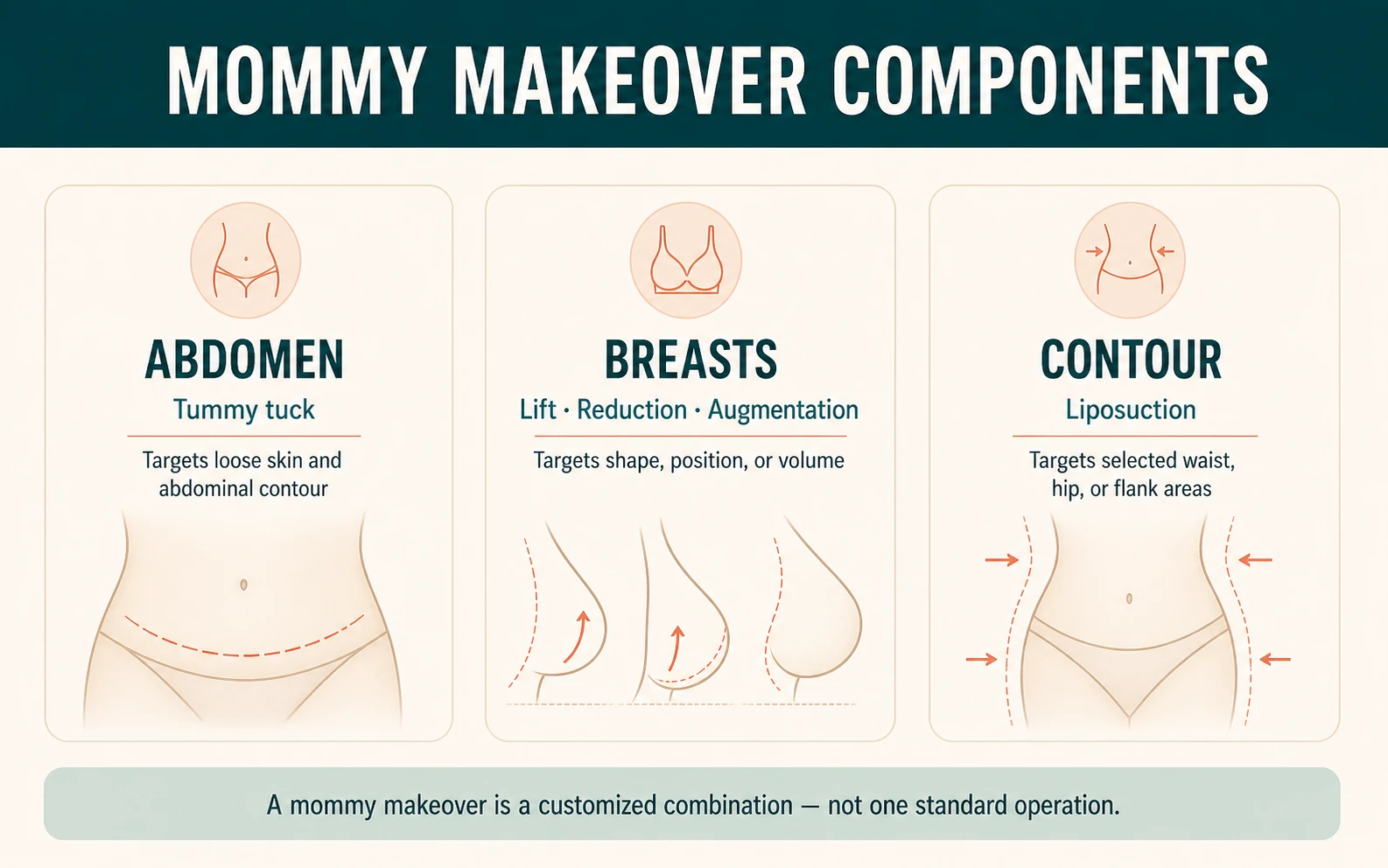
Key Takeaway
Your mommy makeover combination should be driven by your anatomy and goals — not by a fixed package. The most common pairing is tummy tuck plus breast surgery, but your surgeon should recommend a plan based on clinical findings. Combining more procedures saves recovery time but increases operating time and risk. Understanding the trade-offs helps you make an informed decision about what to include and whether staging is appropriate.
There Is No Standard Package
Many marketing materials present the mommy makeover as a defined set of three or four procedures. In practice, it is not a standardized operation: the American Society of Plastic Surgeons describes it as a customized combination selected around each patient’s post-pregnancy concerns.1
This flexibility is the point. Pregnancy affects bodies differently. One woman may experience severe abdominal laxity with minimal breast change. Another may have significant breast ptosis with a well-recovered abdomen. A third may have changes in all areas. The combination should match the individual.
If a surgeon presents a one-size-fits-all package without examining you, consider it a red flag. Your plan should emerge from a thorough consultation, not from a menu.
Most Common Combinations
While every plan is individualised, data from ASPS and published literature show clear patterns:2
Abdomen + Breast (The Classic Pairing)
This is the most frequently performed combination — abdominoplasty with diastasis repair paired with either breast lift, augmentation, or augmentation-mastopexy. It addresses the two areas pregnancy affects most dramatically and typically takes 3.5–4.5 hours.
Recovery involves wearing both an abdominal compression garment and a surgical bra simultaneously. Most patients find the abdominal component more limiting than the breast component in terms of movement restrictions.
Abdomen Only (With Liposuction)
Some patients need only abdominal work — a tummy tuck with muscle repair plus liposuction of the flanks and back for 360-degree contouring. This is common in patients who are satisfied with their breast appearance or who breastfed without significant volume loss.
Operating time is typically 2.5–3.5 hours. Recovery is focused entirely on the torso, which some patients find more manageable than a combined abdominal-breast recovery.
Triple Combination (Abdomen + Breast + Liposuction)
Adding liposuction to the abdomen-plus-breast pairing creates the so-called "triple combo." This typically addresses the abdomen (tummy tuck + muscle repair), breasts (lift or augmentation), and flanks/back/thighs (liposuction).
Operating time ranges from 4.5–5.5 hours. This remains within the safety window for healthy patients, but approaches the threshold where some surgeons recommend staging, based on VTE risk data.3
Extended Combinations
Adding a BBL, arm lift, thigh lift, or labiaplasty to any of the above pushes operating time beyond 6 hours. These extended combinations require careful risk-benefit discussion and often benefit from staging into two sessions.
A mommy makeover with BBL in particular changes the risk profile significantly. See our dedicated mommy makeover with BBL page for the safety data.
How Surgeons Help You Decide
A good consultation for combination surgery involves several steps:
- Physical examination: The surgeon assesses skin quality, elasticity, fat distribution, muscle integrity (checking for diastasis recti), breast position relative to the inframammary fold, nipple position, and tissue volume.
- Goal discussion: What bothers you most? What would make the biggest difference to your daily life and confidence? This helps prioritise when not everything can or should be done at once.
- Medical history review: Previous surgeries, caesarean history, current medications, BMI, smoking status, and comorbidities all influence what can safely be combined.
- Risk-benefit analysis: The surgeon explains what each additional procedure adds in terms of operating time, recovery demands, and complication probability.
- Recovery planning: Can you arrange adequate childcare help? How much time away from work? The combination must be realistic for your support system.
The outcome should be a plan where you understand not just what will be done, but why each component is included and what would change if it were removed.
Body Goals vs Surgical Reality
It is natural to want your pre-pregnancy body back. But it is important to understand what surgery can and cannot accomplish:
- Surgery can: Remove excess skin, repair separated muscles, reposition breasts, reduce or augment breast volume, remove localised fat deposits.
- Surgery cannot: Completely eliminate stretch marks (only those on excised skin are removed), change skin texture globally, reverse all ageing changes, guarantee a specific cup size or exact symmetry.
Setting realistic expectations before surgery is essential. In a prospective study of 611 breast-augmentation patients, satisfaction and psychosocial and sexual well-being improved at six weeks and six months, while physical well-being remained below baseline; older patients also reported lower satisfaction.4 This breast-specific study supports discussing both expected benefits and recovery tradeoffs, but it does not measure every mommy makeover combination.
If reference photos are part of your consultation, discuss with your surgeon what is achievable given your specific anatomy, not just what looks good on another person's body.
The "Everything at Once" Temptation
Combining procedures offers genuine advantages: one anaesthesia session, one recovery period, potentially lower total cost than staged procedures. These benefits are real and for many patients, a combined approach is appropriate and safe.
The temptation, however, is to include every possible procedure to avoid a second surgery — even when the combination pushes into risk territory. Consider these realities:
- Operating time and VTE risk: Procedures lasting over 6 hours show measurably higher rates of deep vein thrombosis and pulmonary embolism.3
- Anaesthesia duration: Longer anaesthesia increases the probability of nausea, hypothermia, and respiratory complications.
- Blood loss accumulation: Each procedure contributes to total blood loss. Combined procedures have higher transfusion rates than any single procedure alone.
- Recovery burden: Recovering from four procedures simultaneously is physically and psychologically harder than two. More pain sites, more restrictions, more garments.
None of this means you should not combine. It means the combination should be chosen with full awareness of these trade-offs — not driven by the desire to "get it all over with."
For a detailed comparison of single-session vs staged approaches, see our staged vs single guide. For combined-procedure risk data, see our safety page.
Questions to Ask Your Surgeon
Before finalising your combination, ask:
- "What is the estimated total operating time?" — This is the single most important safety metric for combined surgery.
- "What is your complication rate for this specific combination?" — Experienced surgeons track their own outcomes, not just published averages.
- "Would staging be safer for my situation?" — A surgeon who never recommends staging may not be appropriately risk-conscious.
- "What would you prioritise if I could only do one procedure?" — This reveals what will make the biggest visual difference.
- "What recovery differences should I expect compared to fewer procedures?" — Understanding the practical recovery impact helps with planning.
- "Why this combination and not an alternative approach?" — The answer should reference your specific anatomy and goals, not a standard package.
A surgeon who welcomes these questions — and answers them with specifics, not generalities — is demonstrating the thoughtfulness you want in someone planning your surgery.
Combination Comparison at a Glance
| Combination | OR Time | Recovery Intensity | Best For |
|---|---|---|---|
| TT + breast lift | 3.5–4.5 h | Moderate | Skin laxity + ptosis |
| TT + breast augmentation | 3–4 h | Moderate | Skin laxity + volume loss |
| TT + lipo (flanks/back) | 2.5–3.5 h | Moderate | Abdomen focus, no breast concerns |
| TT + breast + lipo | 4.5–5.5 h | Moderate-high | Full torso restoration |
| TT + breast + lipo + BBL | 5.5–7+ h | High | Staging recommended |
TT = tummy tuck (abdominoplasty with muscle repair). All times approximate and vary by surgeon and patient anatomy.
Frequently Asked Questions
The most frequently performed combination is abdominoplasty (tummy tuck) plus a breast procedure — either lift, augmentation, or both. This pairing addresses the two areas most commonly affected by pregnancy and breastfeeding.
Multiple procedures can be performed in one session, but there are limits. Most surgeons prefer to keep operating time under 6 hours. If your desired combination would exceed this, staging into two sessions separated by 3–6 months is safer.
Through physical examination (assessing skin laxity, muscle separation, breast position, and fat distribution), review of your medical history, discussion of your goals, and evaluation of your overall health profile including BMI and comorbidities.
Longer operating time correlates with increased risk of venous thromboembolism and other complications. However, for healthy patients within recommended time limits, combined procedures have well-established safety data. The key is matching the combination to the patient.
Ask: What is the estimated operating time? What is the complication rate for this specific combination? Would staging be safer for my situation? What recovery differences should I expect? Why this combination and not an alternative approach?
Key Takeaways
- There is no standard mommy makeover package — your combination should be determined by examination and goals, not a menu.
- The most common pairing is tummy tuck plus breast surgery (lift, augmentation, or both).
- Adding liposuction creates the "triple combo" — effective but pushes operating time toward the 5–6 hour range.
- Extended combinations (4+ procedures) often benefit from staging into two sessions for safety.
- Patient satisfaction depends more on realistic expectations than on the number of procedures performed.
- Ask your surgeon specific questions about operating time, complication rates, and why each component is recommended.
Sources
- American Society of Plastic Surgeons. Mommy Makeover. ASPS. Accessed 2026.
- American Society of Plastic Surgeons. Mommy Makeover. ASPS. 2024.
- Hatef DA, Trussler AP, Kenkel JM. Procedural risk for venous thromboembolism in abdominal contouring surgery: a systematic review of the literature. Plast Reconstr Surg. 2010;125(1):352-362.
- Alderman AK, Bauer J, Fardo D, et al. Understanding the effect of breast augmentation on quality of life: prospective analysis using the BREAST-Q. Plast Reconstr Surg. 2014;133(4):787-795.