
Mommy Makeover Scars: Where They Are & How They Heal
Key Takeaway
A mommy makeover produces visible scars — an abdominal scar along the bikini line and breast scars whose pattern depends on the procedure. Scars are red and raised initially, gradually fading over 12–18 months. The best evidence-based treatments are silicone sheets/gel (started at weeks 4–6), sun protection, and gentle massage. Genetics play a significant role; no treatment eliminates scars entirely.
Abdominal Scars (Tummy Tuck)
Abdominoplasty produces two scars:
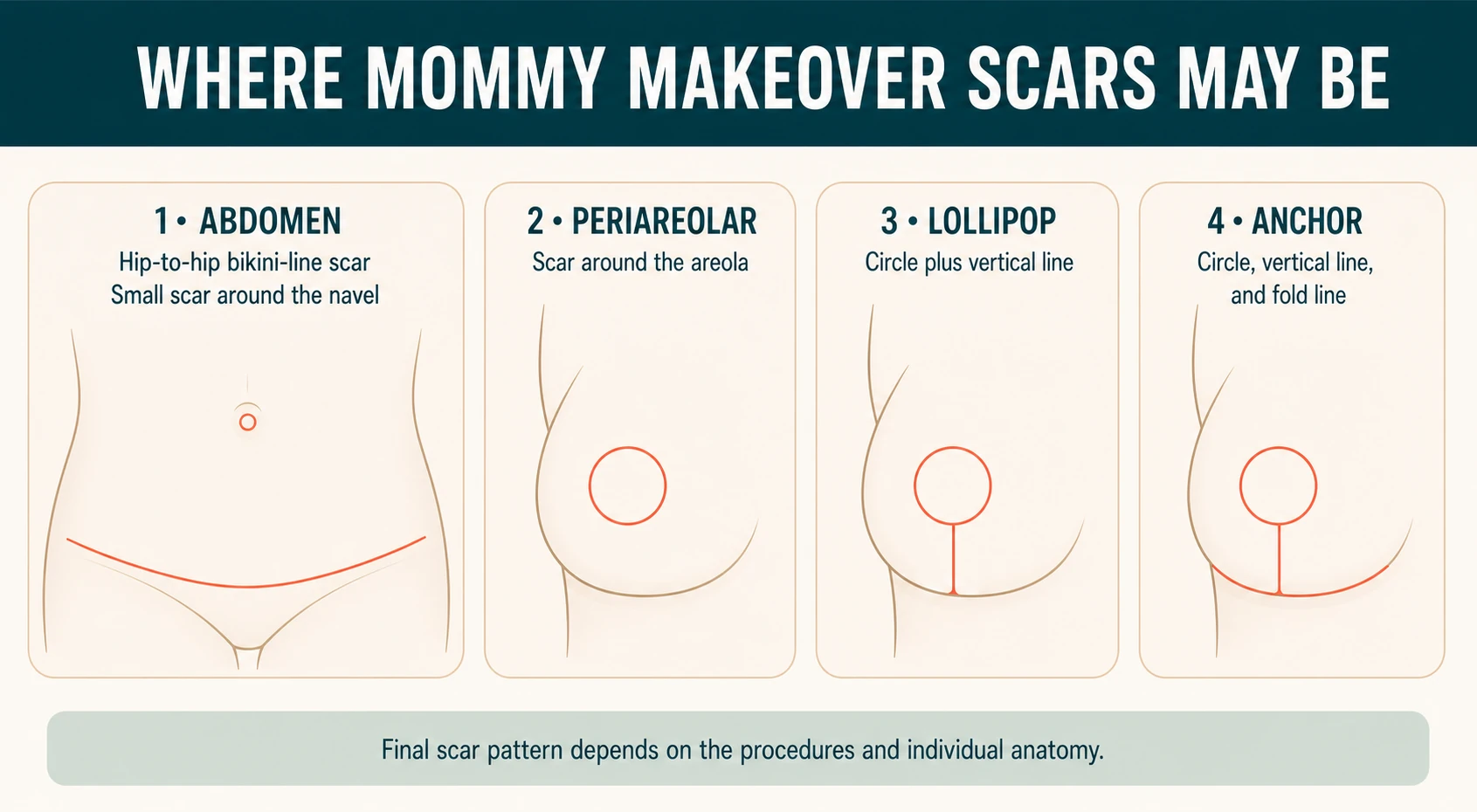
- Main scar: A horizontal incision running from hip to hip, placed low along the bikini line. The exact placement varies by surgeon — most surgeons ask patients to wear their preferred underwear or bikini bottom to the pre-operative appointment so the scar can be planned to sit within the garment line. This scar typically measures 30–50 cm in length.
- Belly button scar: A small circular scar around the navel. During abdominoplasty, the belly button is detached from the skin flap, the skin is pulled down, and the belly button is reinserted through a new opening. The resulting scar is usually well-concealed within the natural contour of the navel.
If you have a cesarean section scar, the tummy tuck incision is usually placed to incorporate and remove the old scar, resulting in a single improved scar rather than two separate ones. This is one of the cosmetic benefits many women appreciate — a cleaner scar line replacing a potentially wide or uneven C-section scar.
Cesarean Scar Tissue and Massage
Many mothers have an older C-section scar before a tummy tuck. In a small, uncontrolled proof-of-concept study of 32 participants, two standardized mobilization sessions were associated with small-to-moderate changes in some C-section scar properties and pain measures.4 The study does not prove effectiveness, establish a long-term protocol, or show that the same result applies to tummy tuck scars. Massage should begin only after the incision is fully closed and the surgeon has cleared it.
Breast Scars
Breast scar patterns depend on the specific procedure:
| Procedure | Scar Pattern | Visibility |
|---|---|---|
| Breast augmentation (implants only) | Inframammary (fold), periareolar (around nipple), or axillary (armpit) | Least visible; 3–5 cm |
| Periareolar lift (mild ptosis) | Circle around the areola only | Minimal; blends with areolar border |
| Vertical / lollipop lift | Around the areola + vertical line from areola to breast fold | Moderate; visible on underside of breast |
| Anchor / inverted-T lift | Around the areola + vertical line + horizontal line along the breast fold | Most extensive but allows maximum tissue reshaping |
The scar pattern is determined by how much tissue needs to be reshaped. More severe ptosis (sagging) requires more extensive incisions. This is not a choice driven by surgeon preference — it is dictated by your anatomy.
Scar Healing Timeline
- Weeks 1–4: Incisions are closed with sutures (sometimes dissolvable), surgical tape, or wound closure strips. The scar line is thin, pink, and slightly raised. This is the inflammatory phase — the body is building new tissue.
- Months 1–3: Scars enter the proliferative phase. They may become redder, firmer, and slightly raised. This is normal and expected. It looks worse before it gets better.
- Months 3–6: The remodeling phase begins. Scars start to soften, flatten, and fade from red/pink toward a lighter tone. This is when you start to see meaningful improvement.
- Months 6–18: Gradual continued maturation. Scars become paler, flatter, and less noticeable. Most scars reach their final appearance between 12 and 18 months.
Evidence-Based Scar Management
Silicone Sheets and Gel
Silicone gel sheets are commonly used for hypertrophic scars, but the evidence is low or very low certainty. A 2021 Cochrane review found limited rigorous randomized-trial evidence and could not establish clear superiority over most alternatives.1 Use them only on fully closed skin and follow your surgeon’s instructions.
- Start once incisions are fully closed and dry (typically weeks 4–6, confirmed by your surgeon)
- Silicone sheets are worn 12–24 hours per day
- Silicone gel is applied twice daily and dries to a thin film
- Continue for 3–6 months for maximum benefit
- Cost: $20–$50 per month
Sun Protection
UV exposure is the enemy of healing scars. According to NHS guidance on scars,3 sunlight causes hyperpigmentation (darkening) of new scar tissue that can be permanent, particularly in darker skin tones. Protect all scars from sun exposure for at least 12 months:
- Physical coverage (clothing) is most reliable
- SPF 30+ broad-spectrum sunscreen on any exposed scar tissue
- This applies to tanning beds as well
Scar Massage
Gentle massage of healed scars (starting at weeks 4–6) helps break up adhesions and soften scar tissue. Use a moisturizer or silicone gel and massage in circular motions for 5–10 minutes, 2–3 times daily. This also helps with the tingling and tightness that accompany nerve regeneration.
What Does NOT Work
- Vitamin E oil — despite its popularity, randomized controlled trials show no benefit and some patients develop contact dermatitis, as shown in Baumann & Spencer’s research2
- Cocoa butter / Bio-Oil — no clinical evidence for scar improvement over plain moisturizer
- Over-the-counter “scar creams” without silicone — marketing without evidence
What Determines How Your Scars Turn Out
Two patients can have identical incisions from the same surgeon and end up with very different-looking scars. A retrospective analysis of 361 hypertrophic scars tracked over five years found that scar maturation is highly variable and influenced by a combination of factors rather than any single cause.5 The main variables are:
- Genetics: A family history of thick, raised, or keloid scarring is the single strongest predictor of how you will scar. This cannot be changed, only managed.
- Skin tone: Deeper skin tones carry a higher risk of both hyperpigmentation and keloid formation, making sun protection and early silicone use especially important.
- Wound tension: Incisions under more mechanical tension — common in abdominoplasty, where skin is pulled taut — tend to widen and thicken more than low-tension incisions. This is why lifting restrictions in the first 6 weeks matter so much.
- Smoking: Nicotine constricts blood vessels and impairs the oxygen delivery scar tissue needs to remodel properly, which is one of several reasons surgeons require smoking cessation before and after surgery.
- Age: Younger skin tends to produce more collagen during healing, which can mean redder, more raised scars initially — but also faster fading over time.
- Nutrition: Adequate protein, vitamin C, and zinc intake support collagen synthesis; malnutrition or crash dieting after surgery can slow and disrupt healing.
- Infection or wound-healing complications: Any delayed healing, wound separation, or infection during the early weeks increases the likelihood of a wider or more noticeable final scar.
Because so much of this is outside your control, the goal of scar management is not to eliminate scars — it is to give your genetics the best possible conditions to produce the least noticeable result.
Hypertrophic Scars and Keloids
Some patients develop problem scars despite good management:
- Hypertrophic scars (5–15%) are raised, thick, red scars that stay within the boundaries of the original incision. They often improve with time, pressure therapy, silicone treatment, and sometimes corticosteroid injections.
- Keloids (<1% in Caucasian patients; 5–15% in patients with darker skin) extend beyond the original incision boundaries and do not spontaneously improve. Treatment options include corticosteroid injections, pressure therapy, and in some cases surgical revision with adjunctive therapy.
Risk factors for poor scarring include genetics (family history of keloids), darker skin tones, wound tension, infection during healing, and premature return to activity. Discuss your scar history with your surgeon during consultation.
When to Consider Scar Revision
If you’re unhappy with a scar after 12–18 months (once full maturation has occurred), revision options include:
- Surgical scar revision (excision and re-closure under reduced tension)
- Laser resurfacing (fractional CO2 or pulsed dye laser)
- Dermabrasion
- Steroid injections for hypertrophic scars
Do not seek revision before 12 months — scars continue to improve naturally throughout the first year, and early revision may produce a worse result.
Living With Your Scars
Beyond the clinical healing timeline, most patients want to know how their scars will fit into everyday life — swimwear, intimacy, and simple day-to-day confidence.
- Swimwear and clothing: The abdominal scar is deliberately placed low, within the bikini line most patients already wear, so a well-planned scar is typically hidden by standard swimwear and underwear once healed and faded.
- Tanning and beach days: Because sun exposure can permanently darken an immature scar, plan beach vacations and sun holidays for at least 12 months after surgery, or keep the scar fully covered with clothing or high-SPF sunscreen until then.
- Sensation changes: Numbness, tingling, or itching along the scar line is common as nerves regenerate and can persist for several months to over a year. This is a normal part of healing, not a sign of a problem.
- Emotional adjustment: Many women feel self-conscious about scars in the first few months when they are at their most visible — red, raised, and freshly healed. Patient-reported outcome studies on scar impact after body-contouring surgery consistently find that satisfaction with the overall result improves as scars mature, even when the scar itself is still visible.
- Intimacy: Most surgeons advise waiting until incisions are fully closed and cleared at a follow-up visit (typically 4–6 weeks) before resuming any activity that puts tension or friction on the scar area.
Frequently Asked Questions
-
A hip-to-hip scar along the bikini line plus a belly button scar from the tummy tuck, and breast scars whose pattern (periareolar, lollipop, or anchor) depends on the specific procedure.
-
Scars are red and raised for 2–3 months, then gradually soften and fade over 6–12 months, with final maturation at 12–18 months. Speed depends on genetics, skin tone, and scar management.
-
Silicone sheets or gel (the only evidence-based topical treatment), started at weeks 4–6 and used for 3–6 months. Sun protection (SPF 30+ or physical coverage) for 12 months. Gentle scar massage starting at 4–6 weeks.
-
No treatment eliminates a scar completely — the goal of scar management is to make it as thin, flat, and pale as your genetics allow. With good care, most scars fade to a fine, light line by 12–18 months that is far less noticeable than during early healing, but some visible mark typically remains.
-
Compression garments are worn primarily to control swelling and support the surgical area, but the steady pressure they apply can also help keep early scar tissue flatter. They are not a substitute for silicone therapy, which has stronger direct evidence for scar quality.
-
Not inherently — how your previous C-section scar healed (whether it is thin and flat, or thick and raised) is a reasonable indicator of your general scarring tendency, but the tummy tuck usually removes and replaces that scar with a single, better-placed incision rather than adding a second one.
Key Takeaways
- Mommy makeover scars include a hip-to-hip abdominal scar and breast scars whose pattern depends on the procedure.
- Scars look worst at months 1–3 (red, raised) before gradually fading over 12–18 months.
- Silicone therapy is the only evidence-based topical treatment for scar improvement.
- Sun protection is critical — UV exposure can permanently darken new scars.
- Vitamin E oil and most “scar creams” have no clinical evidence of effectiveness.
- Wait at least 12 months before considering scar revision — scars continue improving naturally.
Sources
- Jiang Q, Chen J, Tian F, et al. Silicone gel sheeting for treating hypertrophic scars. Cochrane Database Syst Rev. 2021;9(9):CD013357.
- Baumann LS, Spencer J. The effects of topical vitamin E on the cosmetic appearance of scars. Dermatol Surg. 1999;25(4):311-5.
- NHS. Scars. National Health Service (UK). 2023.
- Gilbert I, Gaudreault N, Gaboury I. Exploring the Effects of Standardized Soft Tissue Mobilization on the Viscoelastic Properties, Pressure Pain Thresholds, and Tactile Pressure Thresholds of the Cesarean Section Scar. J Integr Complement Med. 2022;28(4):355-362.
- Kant S, van den Kerckhove E, Colla C, et al. Duration of Scar Maturation: Retrospective Analyses of 361 Hypertrophic Scars Over 5 Years. Adv Skin Wound Care. 2019;32(1):26-34.