
What Does a Mommy Makeover Include? Components Explained
Key Takeaway
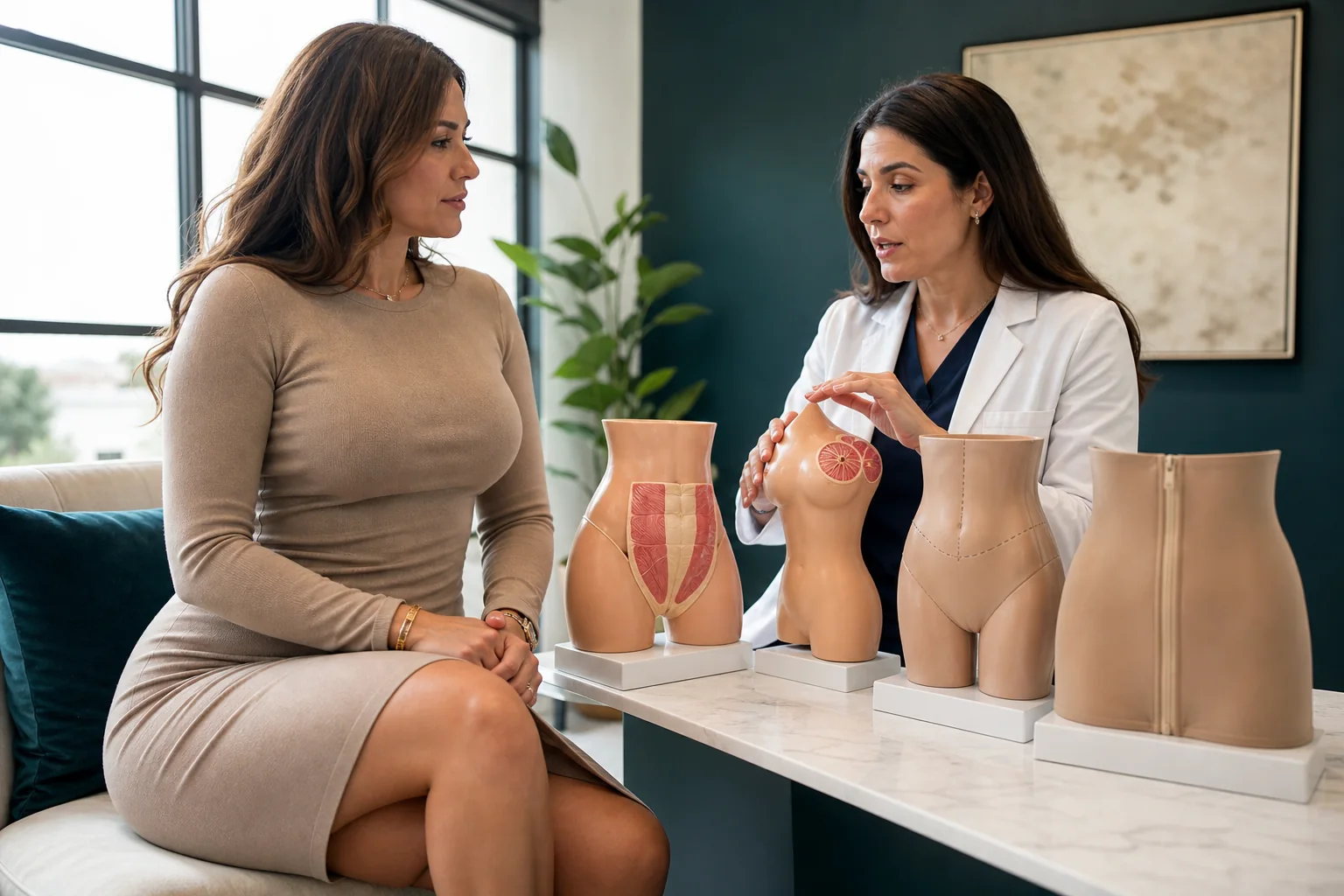
A mommy makeover is not a single operation — it is a customised combination of procedures performed in one session to address post-pregnancy changes. The most common components are abdominoplasty (tummy tuck), a breast procedure (lift, augmentation, or reduction), and liposuction for body contouring. Your surgeon selects which elements to include based on your anatomy, goals, and health profile.
Not One Operation — A Customised Combination
The term "mommy makeover" is not a medical procedure name. It is an umbrella label for a combination of body-contouring surgeries performed during the same anaesthetic session, designed to address the physical changes of pregnancy, breastfeeding, and postpartum weight fluctuation, as described by the American Society of Plastic Surgeons.1
No two mommy makeovers are identical. One patient may need only a tummy tuck and breast lift; another may require abdominoplasty, breast augmentation, and flank liposuction. The combination is driven entirely by clinical findings and personal goals — not by a fixed menu.
This matters because understanding the components helps you have a more informed consultation. You are not "ordering" from a set list. You are working with a board-certified plastic surgeon to identify which specific procedures address your concerns.
The Abdominal Component: Tummy Tuck in Context
Abdominoplasty is one of the procedures commonly considered in a mommy makeover, but it is not automatically included. The combination is individualized, as described by the American Society of Plastic Surgeons.1 In the mommy makeover context, the tummy tuck can address three pregnancy-related changes:
- Excess skin: Stretched abdominal skin that has lost elasticity and will not retract with diet or exercise alone.
- Diastasis recti: Separation of the rectus abdominis muscles along the midline, which occurs in up to 60% of postpartum women at six months.3 Surgical repair (plication) restores core integrity.
- Subcutaneous fat deposits: Localised fat in the lower abdomen that persists despite reaching a stable weight.
The extent of abdominoplasty varies. A full tummy tuck involves a hip-to-hip incision and navel repositioning. A mini abdominoplasty addresses only the area below the navel and uses a shorter incision. Your surgeon determines which approach is appropriate based on the degree of laxity and muscle separation.
What Abdominoplasty Does Not Do
A tummy tuck does not significantly reduce visceral (deep) fat, does not eliminate all stretch marks (only those on excised skin), and does not replace weight loss. It is a contouring procedure, not a weight-reduction procedure.
The Breast Component: Lift, Implants, or Reduction
Breast surgery may be included when pregnancy-related changes involve volume loss, ptosis (sagging), or both, but it is not a required component of every mommy makeover. The breast procedure selected depends on the specific change:
- Mastopexy (breast lift): Repositions the nipple-areola complex and removes excess skin. Ideal when volume is adequate but the breast has descended.
- Augmentation (implants): Restores lost volume using saline or silicone implants. Chosen when deflation is the primary concern but the breast position is acceptable.
- Augmentation-mastopexy: Combines both — lifts the breast and adds volume. This is one of the more technically demanding combinations.
- Reduction: Removes excess tissue and skin. Some women develop persistent macromastia after pregnancy and prefer a smaller, more proportional result.
The breast component adds 1–2 hours to the overall procedure depending on complexity. For a deeper discussion of these options, see our guide to breast options in a mommy makeover.
Body Contouring: Liposuction in the Mommy Makeover
Liposuction is frequently added to refine areas adjacent to the primary procedures. Within a mommy makeover, the most common liposuction sites are:
- Flanks (love handles) — smooths the transition between back and abdomen
- Upper back / bra roll
- Inner and outer thighs
- Upper arms
Liposuction removes localised, exercise-resistant fat deposits. It is not a weight-loss tool. The volume typically removed in a mommy makeover context ranges from 1–3 litres total across all sites, as reported in Aesthetic Surgery Journal.4
When combined with abdominoplasty, circumferential liposuction of the flanks and back produces a more harmonious 360-degree result than abdominoplasty alone. Most surgeons perform liposuction first, then proceed to the tummy tuck.
Optional Additions
Beyond the three core components, some patients include:
- Labiaplasty: Addresses labial hypertrophy that may have developed or worsened after vaginal delivery.
- Fat transfer to buttocks (BBL): Uses liposuctioned fat to enhance gluteal volume. This significantly changes the risk profile — see our mommy makeover with BBL guide.
- Arm lift (brachioplasty): Removes excess skin from the upper arms when liposuction alone is insufficient.
- Thigh lift: Addresses medial thigh skin laxity, though this is less common in post-pregnancy patients.
Each addition extends operating time and recovery. Your surgeon will weigh the benefit of addressing everything at once against the increased surgical duration and cumulative risk. For extended combinations, staging the procedures may be recommended.
What Determines Your Combination?
Five factors shape the surgical plan:
- Physical examination: Skin quality, degree of ptosis, muscle integrity, fat distribution.
- Your goals: What bothers you most? Some patients prioritise the abdomen; others focus on breast shape.
- Health status: BMI, comorbidities, smoking history, and prior surgeries influence what can safely be combined.
- Risk tolerance: Longer procedures carry incrementally higher anaesthesia and VTE risk. Understanding your comfort with combined vs staged surgery matters.
- Recovery logistics: Who will help with childcare? How much time can you take off? A three-procedure combination requires more support than a single procedure.
A thorough consultation involves discussing all five. If a surgeon offers a fixed package without examining you, that is a red flag. For more on choosing your combination, see our combinations guide.
Average Procedure Time by Combination
| Combination | Typical OR Time | Notes |
|---|---|---|
| Tummy tuck only | 2–3 hours | Includes muscle repair |
| Tummy tuck + breast lift | 3.5–4.5 hours | Most common pairing |
| Tummy tuck + breast augmentation | 3–4 hours | Slightly faster than lift |
| Tummy tuck + breast lift + liposuction | 4.5–5.5 hours | Triple combo |
| Tummy tuck + breast + lipo + BBL | 5.5–7+ hours | Extended; staging often recommended |
Most surgeons prefer to keep total operating time under 6 hours. Beyond this threshold, studies show a measurable increase in venous thromboembolism (VTE) risk and complications.5 When the planned combination would exceed this, staging into two sessions is the safer approach.
Understanding the time implications also helps you prepare for recovery. Longer procedures generally mean more post-operative fatigue and a slightly longer initial recovery phase, even if the total recovery timeline is ultimately similar.
The Safety Consideration
Combining procedures has clear advantages — one anaesthesia session, one recovery period, one set of pre-operative costs. But combination surgery is not without trade-offs. Each additional procedure adds operating time, and longer surgeries correlate with higher complication rates.5
This does not mean combined surgery is unsafe. It means the combination must be chosen thoughtfully. A healthy, non-smoking patient at a stable BMI undergoing a 4-hour tummy tuck plus breast lift has a well-established safety profile. A patient with elevated BMI undergoing a 7-hour quadruple procedure faces a different risk equation.
For a detailed discussion of combined-procedure risks, read our combined procedure risk guide.
Frequently Asked Questions
A mommy makeover is performed as a single surgical session combining two or more procedures, most commonly abdominoplasty and a breast procedure. However, the specific combination is customised for each patient based on anatomy and goals.
Yes. Liposuction of the flanks, thighs, or upper arms is one of the most common additions. It typically adds 30–60 minutes of operating time and is considered low-risk when combined with abdominoplasty.
Operating time ranges from 3–6 hours depending on the combination. A tummy tuck plus breast lift averages 4 hours; adding liposuction or muscle repair extends this by 30–90 minutes.
No. There is no mandatory combination. Some patients need only an abdominal procedure, others only breast surgery. Your surgeon assesses which components address your specific concerns and recommends accordingly.
Three factors: your physical examination findings (skin laxity, diastasis recti, breast ptosis), your personal goals, and your overall health profile. A thorough consultation maps these factors to a surgical plan.
Key Takeaways
- A mommy makeover is a customised combination — not a fixed procedure — tailored to your anatomy and goals.
- The three core components are abdominoplasty, breast surgery, and liposuction, but not all patients need all three.
- Abdominoplasty addresses excess skin, diastasis recti, and localised fat in one procedure.
- Breast options range from lift-only to augmentation to reduction, depending on post-pregnancy changes.
- Operating time typically ranges from 3–6 hours; longer combinations may warrant staging for safety.
- A proper consultation evaluates your examination findings, goals, health, risk tolerance, and recovery logistics before recommending a plan.
Sources
- American Society of Plastic Surgeons. Mommy Makeover. ASPS. 2024.
- Sperstad JB, Tennfjord MK, Hilde G, et al. Diastasis recti abdominis during pregnancy and 12 months after childbirth: prevalence, risk factors and report of lumbopelvic pain. Br J Sports Med. 2016;50(17):1092-6.
- Hoyos AE, Millard JA. VASER-assisted high-definition liposculpture. Aesthet Surg J. 2007;27(6):594-604.
- Hatef DA, Trussler AP, Kenkel JM. Procedural risk for venous thromboembolism in abdominal contouring surgery: a systematic review of the literature. Plast Reconstr Surg. 2010;125(1):352-362.