
The “Mom Pooch”: What’s Actually Causing It
Key Takeaway
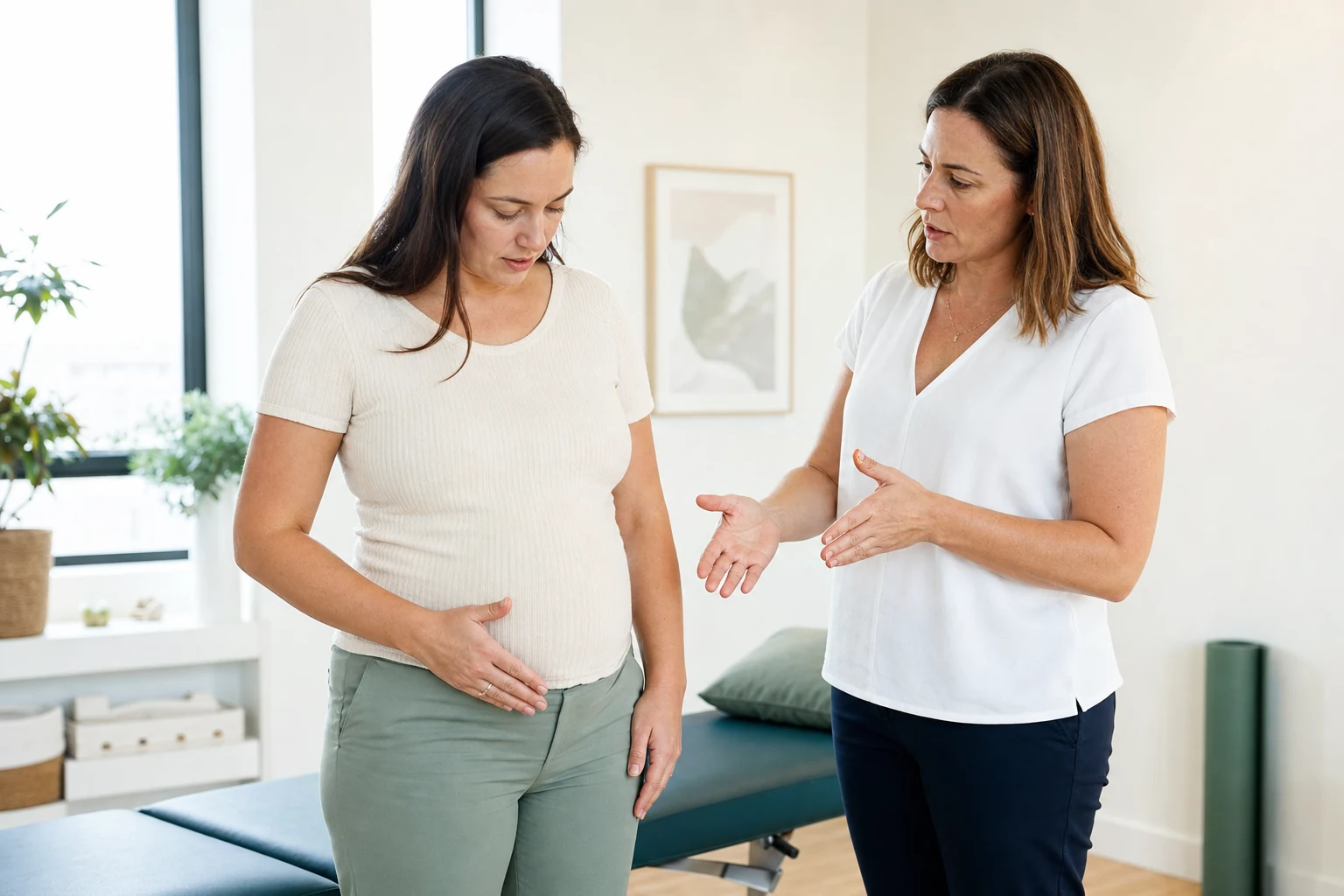
The “mom pooch” is not a single thing — it is a combination of skin laxity, abdominal muscle separation, fat redistribution, and connective tissue changes that happen during pregnancy. It affects women after both vaginal and cesarean deliveries. Understanding what is actually causing yours is the key to knowing what can realistically help.
The Term Covers Several Different Things
The term “mom pooch” is informal and carries no medical definition. It is the word women use to describe the persistent lower abdominal fullness, softness, or protrusion that remains after pregnancy and childbirth — often despite returning to pre-pregnancy weight.
Because it is a lay term, what one woman calls her pooch may be almost entirely loose skin, while on another it is diastasis recti with tight skin, and on a third it is a c-section scar shelf combined with fat redistribution. Treating it as a single condition is why so much of the advice online misses the mark — the honest first step is figuring out which combination you actually have.
It is one of the most common postpartum body concerns, and it is surrounded by misinformation. Social media is full of “before and after” transformations, magic exercises, and products promising to eliminate it. The reality is more nuanced, and understanding the actual anatomy is the first step toward realistic expectations.
Possible Causes
A postpartum belly is usually a combination of the four factors below. A physical exam by a physical therapist or physician trained in postpartum assessment is the most reliable way to tell which are contributing most in your case.
Skin Laxity
During pregnancy, the abdominal skin stretches to accommodate a growing uterus that increases from roughly the size of a pear to the size of a watermelon. This stretching can exceed the skin’s elastic capacity, particularly in the lower abdomen where stretching is greatest.
After delivery, the skin retracts — but how much it retracts depends primarily on genetics, age, the degree of stretching (related to baby size, multiple pregnancies, and carrying multiples), and skin quality. Some women’s skin contracts remarkably well; others have permanent laxity that leaves loose, crepey skin in the lower abdomen.
No exercise, cream, or device can tighten loose skin. This is a tissue quality issue, not a fitness issue. When skin laxity is the primary cause of the mom pooch, abdominoplasty is the only intervention that addresses it directly — but that decision is personal and should never be pressured.
Fat Distribution Changes
Pregnancy and breastfeeding shift how the body stores fat. Estrogen, progesterone, cortisol, and prolactin all influence adipose distribution, and many women notice that fat settles preferentially in the lower abdomen, hips, and outer thighs even after their weight returns to a pre-pregnancy number.2 Where the body stores — and releases — fat is determined by genetics and hormones, not by which exercise you choose.
Abdominal Muscle Changes
Diastasis recti abdominis (DRA) is the widening and thinning of the linea alba — the connective tissue between the left and right rectus abdominis muscles. It occurs during pregnancy as hormonal changes soften connective tissue and the expanding uterus pushes the muscles apart.1
Research shows that approximately 100% of women have some degree of diastasis by the third trimester. By 12 months postpartum, about 33% still have a separation greater than 2 finger-widths.1
When the muscles remain separated, the abdominal wall cannot generate the tension needed to hold everything flat. The result is a rounded, protruding lower abdomen that may be more noticeable when standing or performing abdominal exertion.
This is the most treatable cause of the mom pooch. Targeted core rehabilitation — focused on the transverse abdominis, internal obliques, and pelvic floor — can significantly reduce diastasis and improve both function and appearance. A women’s health physical therapist is the best resource for this individualized work; general fitness advice is not a substitute for a hands-on assessment.
Scar Tethering (After a C-Section)
For women who delivered by cesarean, the abdominal scar can adhere to underlying tissue and pull the skin above it downward, creating a visible ledge or shelf. This is the c-section shelf, and it is a distinct cause of what women often lump under “mom pooch.” Gentle scar mobilization by a pelvic health PT can release many of these adhesions; see our c-section scar massage guide and the c-section pooch overhang guide for depth.
How It Differs from a C-Section Shelf
The mom pooch and the c-section shelf are related but distinct:
| Feature | Mom Pooch | C-Section Shelf |
|---|---|---|
| Occurs after | Any delivery (vaginal or cesarean) | Cesarean delivery only |
| Primary causes | Skin laxity, diastasis recti, fat redistribution | Scar adhesion/tethering + same as mom pooch |
| Appearance | General lower abdominal fullness or protrusion | A distinct fold or ledge at the scar line |
| Scar involvement | No scar factor | Scar tethering creates the visible shelf |
| Scar massage helps? | Not directly | Yes, releases adhesions |
A woman who had a cesarean delivery can have both a mom pooch (from the pregnancy itself) and a c-section shelf (from scar adhesion). The c-section pooch guide covers the overlapping causes in detail.
Why “Spot Reduction” Doesn’t Work
One of the most persistent myths about the mom pooch is that specific abdominal exercises — enough crunches, planks, a dedicated “lower-ab” program — can burn fat off the belly and leave the rest of the body untouched. The exercise-science research on this is unusually clear: spot reduction is not a real phenomenon. Fat is mobilized from adipose stores throughout the body based on hormonal signaling, not on which muscle is being worked underneath.2
Direct abdominal exercise strengthens the muscles underneath the mom pooch, which can improve posture and function, but it does not preferentially strip fat from the skin above it. Worse, some of those exercises — traditional crunches and full sit-ups — increase forward intra-abdominal pressure and can widen an existing diastasis, making the pooch look larger, not smaller. Programs that promise to “target belly fat” through ab work alone are selling something the physiology does not deliver.
What Genuinely Helps
Core Rehabilitation
If diastasis recti is a contributing factor, targeted core rehabilitation is the single most impactful non-surgical intervention. This is not “doing crunches” — in fact, traditional crunches and sit-ups can worsen diastasis by increasing forward pressure on the already-weakened linea alba.
Effective diastasis rehabilitation focuses on the deep core system:1
- Transverse abdominis (TrA): The deepest abdominal muscle, which acts as a natural corset
- Pelvic floor: Works in concert with the TrA to stabilize the core
- Diaphragm: Proper breathing patterns coordinate with core activation
- Multifidus: Deep back muscles that support spinal stability
A women’s health physical therapist can design a progressive program that starts with awareness and activation, then builds to functional strength. Many women see meaningful improvement in abdominal appearance and function within 3–6 months of consistent work.
Sustainable Physical Activity
Regular physical activity supports overall body composition and can reduce the fat component over time. The key word is “sustainable” — extreme restriction or excessive exercise are counterproductive, especially in the postpartum period when energy demands are high.
Walking, swimming, cycling, strength training, and group fitness all count. The best exercise is the one you can maintain consistently. For guidance on returning to exercise after cesarean delivery, see our exercise after c-section guide.
Time and Patience
This is genuinely important and genuinely undervalued. The body continues to heal and change for 12–18 months after delivery. Hormonal shifts during breastfeeding further influence body composition. Many women who are distressed at 4 months postpartum see meaningful natural improvement by 12 months.
What Time Alone Won’t Fix
Waiting is genuinely part of postpartum healing — but time is not a universal solvent. Some causes respond to time (early swelling, hormonal fat redistribution, mild diastasis) and some largely do not:
- Loose or crepey skin that persists at 12–18 months tends to remain. The dermis has finite elastic recovery, and once collagen and elastin fibers rupture during rapid stretching, the tissue does not fully reweave itself.
- Wide diastasis recti (typically greater than 2–3 finger-widths at 12 months) rarely closes to a normal gap without focused rehab — and in some women, not even then.
- A tethered c-section scar that has been left alone for years usually needs manual therapy or, in stubborn cases, surgical release. It will not smooth out on its own.
- Skin containing mature stretch marks keeps its texture indefinitely. Waiting does not fade the structural change (see our stretch marks after pregnancy guide for what actually does).
Recognizing what time can and cannot do is not a reason to rush toward surgery; it is a reason to invest early rehab effort in the components that do respond, and to make peace with (or plan around) the ones that will not.
Social Media vs. Reality
Social media creates a distorted picture of postpartum bodies. The problems are well-documented:
- Survivorship bias: Women who “bounce back” quickly are more likely to post — those whose bodies change permanently are less visible in these spaces
- Genetic variation is invisible: A woman who naturally has excellent skin elasticity and minimal diastasis may look the same at 8 weeks postpartum as she did before pregnancy. This is genetics, not a product she used or an exercise she did.
- Lighting, posture, and timing: Before/after photos can be dramatically influenced by lighting, posture, time of day (bloating varies), and strategic clothing
- Products and programs: Many “transformation” posts are advertisements for supplements, wraps, or fitness programs that cannot deliver what they promise
The mom pooch is not a problem to be solved by a 21-day program. It is a combination of anatomical changes, some of which respond to rehabilitation and time, and some of which are permanent features of a body that grew a human being.
When Surgery Becomes a Reasonable Question
If you have given your body adequate time to heal (12–18 months minimum), worked with a physical therapist on core rehabilitation, reached a stable weight, and still have a mom pooch that affects your quality of life, it is reasonable to discuss options with your healthcare provider.
Surgical options like abdominoplasty can address skin laxity and diastasis simultaneously. But this is a personal decision, not a medical necessity. There is nothing wrong with having a mom pooch, and there is nothing wrong with wanting to address it. Both positions are valid.
Frequently Asked Questions
Is the mom pooch permanent?
It depends on the cause. Some degree of postpartum abdominal change is very common and, for many women, permanent. Diastasis recti can improve significantly with targeted physical therapy. Skin laxity is largely determined by genetics and does not reverse with exercise. Fat distribution can change with overall body composition. Most women see the most improvement in the first 12–18 months postpartum.
What is the difference between a mom pooch and a c-section shelf?
The “mom pooch” can happen after any delivery — vaginal or cesarean — and refers to general lower abdominal fullness caused by skin laxity, muscle changes, and fat redistribution. The “c-section shelf” is specific to cesarean delivery and involves a visible fold or tethering at the scar line caused by scar adhesion. A woman who had a c-section can have both.
Can exercise fix a mom pooch?
Exercise can address the muscle component (diastasis recti) and support overall body fat changes, but it cannot fix loose skin or reverse all pregnancy-related changes. Core rehabilitation with a focus on the deep stabilizing muscles — transverse abdominis and pelvic floor — is more effective than traditional ab exercises like crunches, which can worsen diastasis.
Why do some women get a mom pooch and others don’t?
Genetics play the largest role — skin elasticity, connective tissue strength, and body composition are heavily genetically influenced. Other factors include the degree of abdominal stretching during pregnancy (related to baby size and multiple pregnancies), age, overall fitness before pregnancy, and hormonal factors. It is not a reflection of effort or lifestyle choices.
Will a mom pooch go away on its own?
Some components can improve on their own within the first 12–18 months postpartum — early swelling, hormonal fat redistribution, and mild diastasis often improve with time. Loose skin, wide muscle separation, a tethered c-section scar, and mature stretch marks generally do not resolve without focused intervention. The honest answer depends on which components are contributing to your specific mom pooch.
Key Takeaways
- The “mom pooch” is a combination of skin laxity, diastasis recti, and fat redistribution — not a single condition
- It happens after both vaginal and cesarean deliveries because it is caused by pregnancy, not by delivery method
- Diastasis recti is the most treatable cause through targeted core rehabilitation with a PT
- Skin laxity cannot be fixed with exercise, creams, or wraps
- Social media misrepresents postpartum body changes through survivorship bias and marketing
- Give your body 12–18 months before assessing what is permanent; many changes improve with time
Sources
- Sperstad JB, Tennfjord MK, Hilde G, et al. Diastasis recti abdominis during pregnancy and 12 months after childbirth: prevalence, risk factors and report of lumbopelvic pain. Br J Sports Med. 2016;50(17):1092-6.
- ACOG. Physical Activity and Exercise During Pregnancy and the Postpartum Period. Committee Opinion No. 804. 2020.