
C-Section Scar Healing: A Realistic Timeline of What’s Normal
Key Takeaway
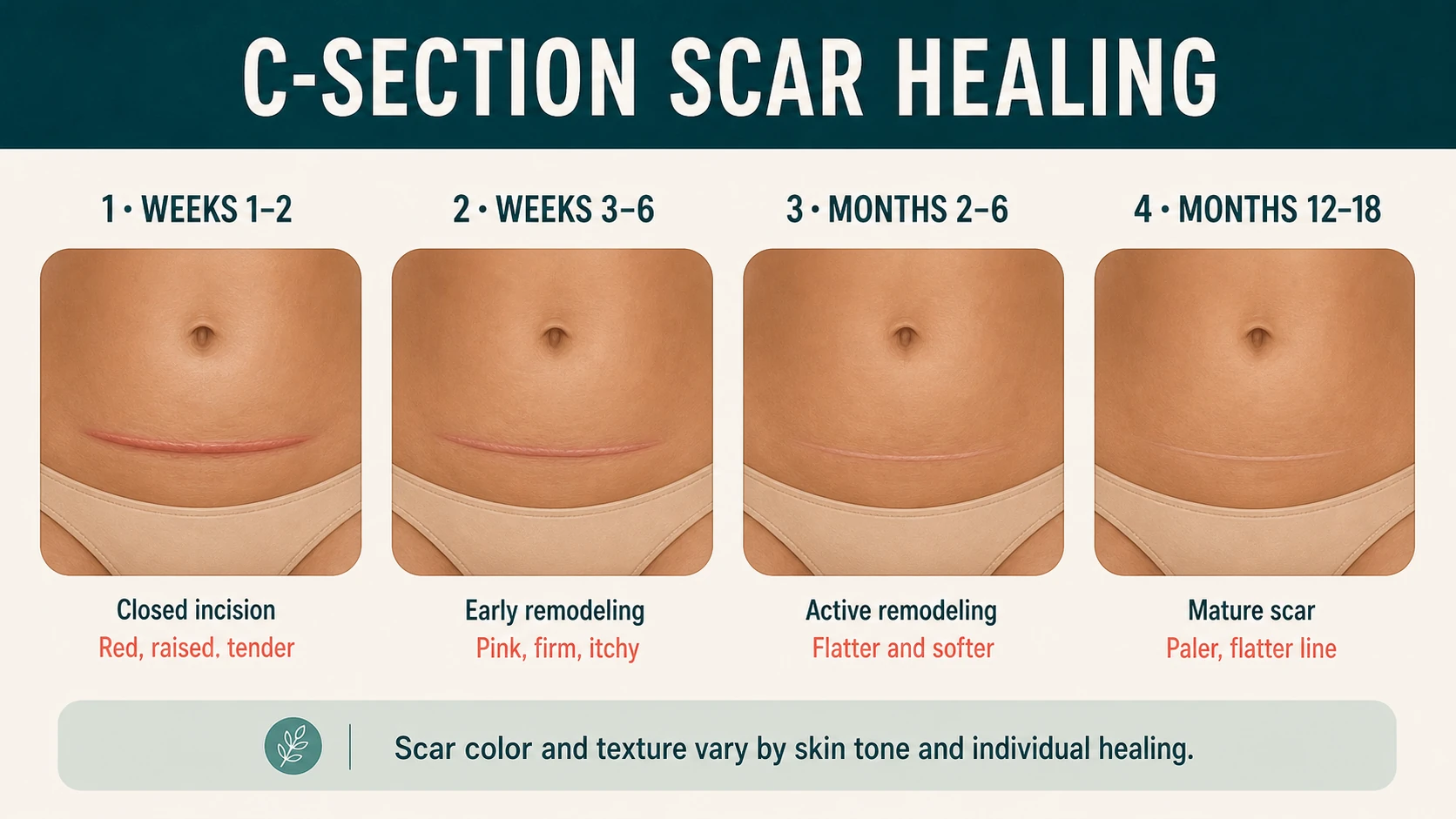
A c-section scar takes 12–18 months to fully mature. The incision surface closes in weeks, but the deeper tissue remodeling that determines your scar’s final appearance continues for over a year. Most of what you experience during this time — itching, numbness, color changes, firmness — is completely normal. Knowing the timeline helps you distinguish routine healing from signs that need medical attention.
What C-Section Scar Healing Actually Looks Like
Every cesarean scar goes through a predictable sequence of healing phases. The speed and intensity vary between individuals, but the overall pattern is remarkably consistent. Understanding this timeline can save you significant anxiety during the months after delivery.
Your c-section incision is typically 10–15 centimeters long (about 4–6 inches) and is placed low on the abdomen, just above the pubic hairline. In most cases, the incision is horizontal — called a Pfannenstiel incision — which heals more favorably and is easier to conceal than the vertical midline incision used in some emergency situations.1
Weeks 1–2: The Inflammatory Phase
In the first two weeks, your body is focused entirely on closing the wound and fighting potential infection. This is the inflammatory phase of healing, and it is supposed to look and feel intense.
During this time, the scar is typically red, raised, and firm to the touch. You may notice mild swelling around the incision line, and the area may feel warm. Some bruising around the edges is common, particularly if staples were used for closure. Steri-strips or surgical glue may still be in place — let these fall off on their own rather than peeling them.
Pain at the incision site is expected during these first weeks and is usually managed with prescribed or over-the-counter pain medication. Sharp stinging sensations when you move, cough, or stand from a seated position are normal as the tissue is still fresh.
What to watch for: A small amount of clear or light yellow fluid at the incision edges can be normal. However, any thick or discolored discharge, foul smell, or increasing redness spreading away from the scar line warrants a call to your provider.
Weeks 3–6: Early Remodeling Begins
By the third week, the surface of the incision is usually sealed. Your body shifts from inflammation to proliferation — the phase where new collagen is laid down to strengthen the wound. The scar may begin to look slightly raised or ropy as collagen builds up beneath the surface.
This is a period when itching may become noticeable as the wound heals and the scar forms. Mild itch can be part of normal healing, but increasing redness, warmth, pain, discharge, or fever needs medical review. MedlinePlus describes itching as a common observation during wound healing.2
The color of the scar during this phase depends on your skin tone. On lighter skin, it is typically dark pink to red. On medium skin tones, it may appear reddish-brown. On darker skin, it can look darker than the surrounding skin or have a purple-brown quality. All of these are normal variations.
Around 6 weeks postpartum, most healthcare providers clear patients for scar massage, which involves gently mobilizing the tissue to prevent excessive adhesion to the underlying layers. This is an important window — starting scar mobilization at the right time can influence how the scar matures. (See our guide to c-section scar massage for techniques.)
Months 2–6: Active Remodeling
This is the phase where visible changes happen most noticeably. The scar begins to flatten and soften as your body remodels the initial collagen. The red or dark color starts to lighten, though it typically remains noticeably different from surrounding skin.
Many women report that their scar feels harder or more ridge-like during months 2–4 before it begins to soften. This is the collagen maturation process and is entirely expected. The firmness does not mean something is wrong — it is a sign that the tissue is actively remodeling.
Numbness around the scar is very common during this period. The area directly above the scar (the skin between the incision and the belly button) often has reduced or altered sensation because small sensory nerves (the ilioinguinal and iliohypogastric nerves) are cut or stretched during the cesarean procedure.3 Tingling or “pins and needles” sensations may come and go as nerves attempt to regenerate.
If the incision is completely closed, your clinician may suggest silicone scar sheets or silicone gel. A 2021 Cochrane review found only limited, low- or very-low-certainty evidence for silicone gel sheeting in hypertrophic scars, so it should be presented as an option rather than a guaranteed treatment.4
Months 6–18: Final Maturation
Scar maturation is the longest phase and the one where patience matters most. During this period, the scar gradually becomes paler, flatter, and softer. The final color depends heavily on your skin tone and genetics — for many women, the scar eventually fades to a thin, pale line that is barely visible. For others, it remains a faint but noticeable mark.
By 12–18 months, the scar has reached its mature state. After this point, significant further changes to appearance are unlikely without intervention. If you are unhappy with your scar after this timeline, that is when conversations about scar revision become relevant — not before.
It is worth noting that each subsequent cesarean delivery can affect the same scar, as the surgeon typically reopens the previous incision. Multiple cesarean deliveries can result in a wider or more pronounced scar due to repeated healing cycles.
Low Transverse vs. Vertical Incisions
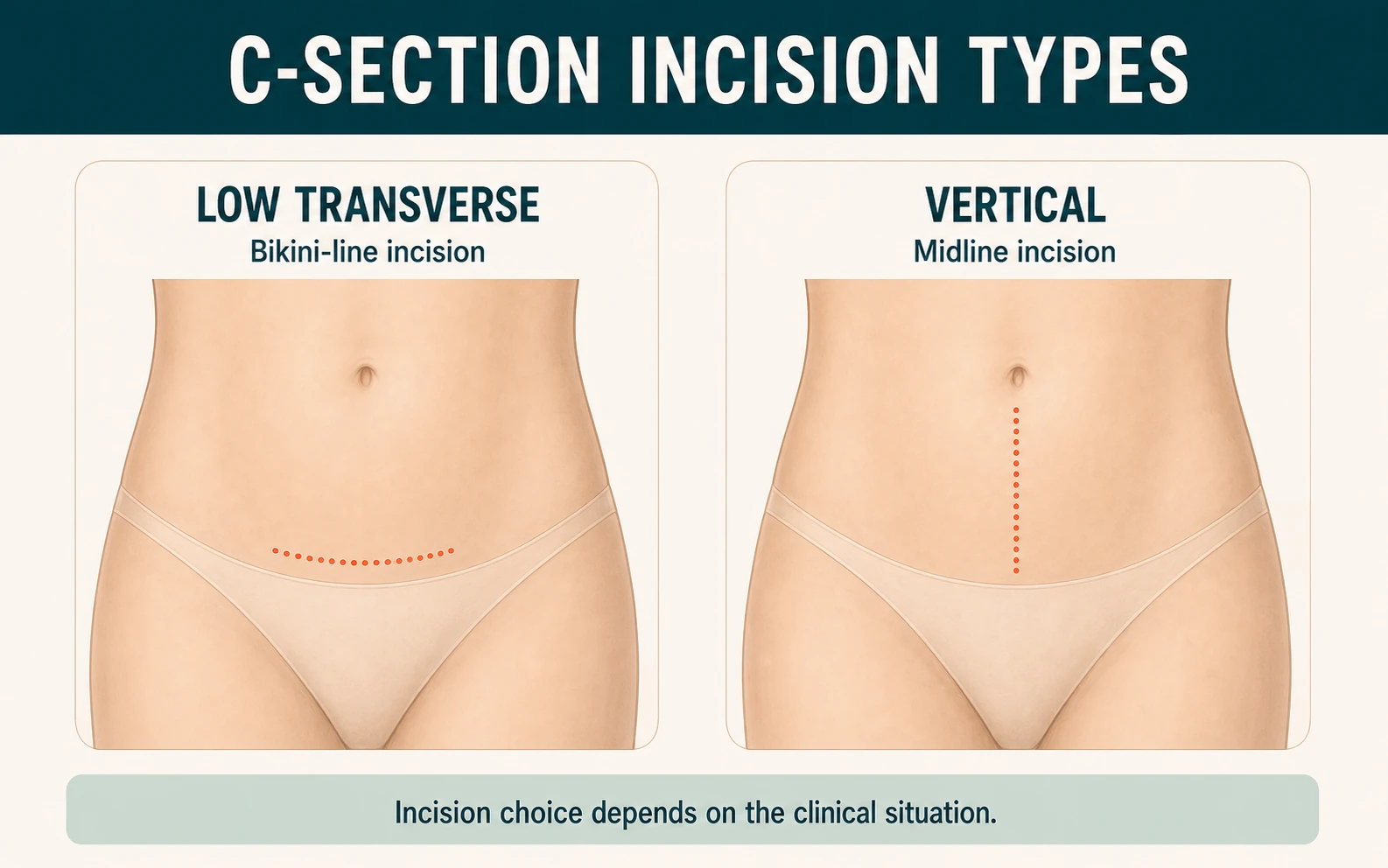
The vast majority of c-sections today use a low transverse (horizontal) incision, which follows the natural skin tension lines of the lower abdomen. This orientation allows the scar to heal under less mechanical stress and is associated with better cosmetic outcomes.1
Vertical (classical) incisions are used in certain emergency situations or when the baby needs to be delivered very quickly. These incisions run from below the belly button toward the pubic area and cross the skin tension lines, which means they are under more tension during healing and tend to produce wider, more visible scars.
If you have a vertical scar, the healing timeline is the same, but the scar is more likely to become hypertrophic (raised) due to the increased tension. Silicone sheeting and scar massage are especially important for vertical incisions.
What’s Normal vs. What Needs Attention
One of the most stressful parts of c-section recovery is not knowing whether what you’re experiencing is typical. Here is a clear breakdown:
Normal During Healing
- Itching: Very common from week 3 onward; caused by nerve regeneration
- Numbness: Expected around and above the scar; may last months to years
- Firmness or ridge: Collagen buildup during months 2–4 before softening
- Color changes: Red → pink → pale (lighter skin) or darkening then fading (darker skin)
- Pulling sensation: Mild tugging during movement, especially bending
- Uneven texture: One end healing slightly differently than the other
Contact your healthcare provider if you notice:
- Spreading redness beyond the scar edges (not just the scar itself being red)
- Increasing warmth, swelling, or tenderness after the first week
- Any discharge that is yellow-green, thick, or foul-smelling
- Fever above 100.4°F (38°C)
- Incision edges separating (wound dehiscence)
- A hard, painful lump near the scar that grows (could be a seroma, hematoma, or endometrioma)
Most of these complications, when they occur, appear within the first 2–4 weeks. Infections after that window are uncommon but not impossible.
Caring for Your C-Section Scar
The First 6 Weeks
During the initial healing period, scar care is primarily about keeping the area clean and protected:
- Gently wash with mild soap and water during showers — no scrubbing
- Pat dry thoroughly; moisture trapped under a fold of skin can promote irritation
- Wear loose, soft-waisted clothing that doesn’t press directly on the incision
- Avoid submerging in baths, pools, or hot tubs until your provider clears you
- Do not apply any creams, oils, or ointments to the incision unless directed by your provider
Silicone Sheets: The Evidence
Silicone sheeting is widely used for raised scars, but the best available randomized-trial evidence remains uncertain. The 2021 Cochrane review concluded that it is unclear whether silicone sheets meaningfully improve clinician-rated scar severity compared with no silicone treatment because the evidence is very low certainty.4
Use silicone only after the incision is fully closed, and follow the product instructions and your clinician’s advice on daily wear time and duration. Stop and seek advice if it causes persistent irritation or skin breakdown.
Sun Protection
Healing scars are highly susceptible to hyperpigmentation from UV exposure. Even indirect sunlight through clothing can contribute to darkening. If your scar is exposed to sunlight — whether at a beach or simply from clothing that doesn’t cover the area — apply SPF 30+ sunscreen to the scar for the first 12–18 months.
Scar Massage: When to Start
Scar massage (also called scar mobilization) involves physically moving the scar tissue to reduce adhesions to the underlying muscle fascia. Most providers recommend starting at 6–8 weeks postpartum, once the surface is completely healed.
Techniques include gentle circular motions, cross-friction (side to side perpendicular to the scar), and skin rolling (lifting the scar between your fingers). The goal is to feel the tissue moving freely rather than being stuck down. For a detailed walkthrough, see our c-section scar massage guide.
Why Some Scars Form a “Shelf”
The c-section shelf — the overhang or fold of tissue above the scar line — is one of the most common cosmetic concerns after cesarean delivery. It forms because of a combination of factors:
- Scar adhesion: The scar tissue can adhere to the underlying fascia, creating a visible tethering point that pulls the skin inward
- Skin laxity: Stretched abdominal skin from pregnancy drapes over the tethered scar line
- Fat distribution: Subcutaneous fat naturally sits differently above and below the scar
- Swelling patterns: Postpartum swelling can take months to resolve, making the shelf more prominent early on
A shelf is not a sign of poor surgical technique. It is a predictable outcome of placing a horizontal incision on an abdomen that has been stretched by pregnancy. For many women, the shelf becomes significantly less noticeable over 12–18 months as swelling resolves and scar tissue matures. For a deeper look at this topic, read our c-section shelf guide.
Numbness and Nerve Recovery
Numbness around a c-section scar is experienced by the majority of women and is caused by small sensory nerves being severed during the incision. The ilioinguinal and iliohypogastric nerves supply sensation to the lower abdomen, and their branches are inevitably cut during a Pfannenstiel incision.3
The area most commonly affected is the skin between the scar and the belly button, as well as the skin immediately around the scar itself. The numbness may extend laterally toward the hip bones.
Nerve regeneration is slow — peripheral nerves regrow at approximately 1 millimeter per day. Most women notice gradual improvement in sensation over 6–12 months, but the recovery is often incomplete. Some degree of altered sensation directly around the scar line may be permanent, and this is considered a normal outcome of the procedure.
Hypersensitivity (the area feeling overly sensitive or tender to light touch) can also occur during nerve recovery and is another normal, if uncomfortable, part of the process.
Keloid and Hypertrophic Scars
Most c-section scars mature into flat, pale lines. However, some women develop excessive scarring:
Hypertrophic scars are raised and firm but stay within the boundaries of the original incision. They are relatively common (estimated to occur in 40–70% of surgical wounds to varying degrees) and usually improve with time and silicone therapy.5
Keloid scars extend beyond the original wound borders, forming firm, sometimes painful growths. True keloids are less common and are more prevalent in individuals with darker skin tones. Genetics play the largest role in keloid formation.5
If you have a history of keloid scarring from other wounds, mention this to your obstetrician before or immediately after your cesarean delivery. Early intervention with silicone therapy and, in some cases, corticosteroid injections can reduce the severity.
Treatment options for excessive scarring include:
- Silicone sheeting (first-line for both hypertrophic and keloid scars)
- Intralesional corticosteroid injections (triamcinolone) — typically administered by a dermatologist
- Pressure therapy
- Laser therapy (pulsed dye laser for redness and color)
When Scar Revision Is Considered
Scar revision is a surgical procedure to improve the appearance of a mature scar. It is only considered after the scar has fully matured — meaning at minimum 12–18 months after delivery, and only after non-surgical options (silicone, massage, and time) have been given a fair trial.
Scar revision may be appropriate when:
- The scar is wide, raised, or discolored despite conservative treatment
- The scar causes physical symptoms like itching, pain, or tightness
- There is significant shelf or tethering that affects daily comfort
It is important to have realistic expectations. Scar revision replaces one scar with a new one — the goal is a scar that heals more favorably, not invisible skin. The same healing timeline (12–18 months) applies to the revised scar.
If you are considering body contouring after pregnancy, such as a mommy makeover, the c-section scar is typically incorporated into the surgical plan rather than addressed separately.
Frequently Asked Questions
How long does a c-section scar take to fully heal?
The surface of a c-section incision typically closes within 2–3 weeks, but the deeper tissue remodeling phase continues for 12–18 months. During this time, the scar gradually transitions from red or pink to a pale, flat line. Final appearance depends on genetics, skin tone, and how well the scar is protected during maturation.
Is itching around my c-section scar normal?
Yes. Itching is one of the most common experiences during c-section scar healing and is caused by nerve regeneration and collagen remodeling in the tissue. It typically begins a few weeks after surgery and can continue intermittently for several months. Avoid scratching the incision; gentle moisturizing and silicone-based products can help relieve the sensation.
When should I worry about my c-section scar?
Contact your healthcare provider if you notice spreading redness beyond the scar edges, warmth or swelling that increases rather than decreases, any discharge (especially if yellow-green or foul-smelling), fever above 100.4°F (38°C), or the incision edges separating. These may indicate infection or wound dehiscence and require prompt medical evaluation.
Do silicone sheets actually help c-section scars?
Yes, silicone sheeting has the strongest clinical evidence of any topical scar treatment. Multiple studies and systematic reviews support their use for reducing scar thickness, redness, and overall appearance. They work by hydrating the scar and regulating collagen production. Most guidelines recommend starting them once the incision is fully closed, typically around 2–3 weeks postpartum.
Will numbness around my c-section scar go away?
Numbness around a c-section scar is very common and results from small sensory nerves being cut during the incision. Most women experience gradual improvement over 6–12 months as nerves regenerate, but some degree of altered sensation can be permanent, particularly directly around the scar line. This is considered a normal outcome of cesarean delivery.
Key Takeaways
- C-section scar healing takes 12–18 months for full maturation — the surface closes in weeks, but deep remodeling continues for over a year
- Itching, numbness, firmness, and color changes are all normal parts of the healing process
- Spreading redness, discharge, fever, or wound separation are not normal and need medical attention
- Silicone sheets have the strongest evidence of any topical scar treatment — start once the incision is fully closed
- Scar massage starting at 6–8 weeks can help prevent adhesions and improve mobility
- Keloid and hypertrophic scarring risk is influenced primarily by genetics and skin type
- Scar revision is only considered after the scar has fully matured (12–18 months minimum)
Sources
- ACOG. Cesarean Birth. American College of Obstetricians and Gynecologists. 2024.
- MedlinePlus. How Wounds Heal. U.S. National Library of Medicine. Reviewed 2024.
- Loos MJ, Scheltinga MR, Mulders LG, et al. The Pfannenstiel incision as a source of chronic pain. Obstet Gynecol. 2008;111(4):839-46.
- Jiang Q, Chen J, Tian F, et al. Silicone gel sheeting for treating hypertrophic scars. Cochrane Database Syst Rev. 2021;9(9):CD013357.
- ASPS. Scar Revision. American Society of Plastic Surgeons. 2024.