
Blood Clots After Surgery (VTE): Risk & Prevention
Key Takeaway
Venous thromboembolism (VTE) — blood clots in deep veins that can travel to the lungs — is the leading cause of death after cosmetic surgery. The risk is highest in the first 2 weeks after surgery and increases with longer procedures, immobility, and personal risk factors. VTE is largely preventable with proper protocols, and recognizing symptoms early can be life-saving.
Call 911 Immediately if You Experience Any of These
Blood clots after surgery are life-threatening. Do not wait, do not drive yourself:
- Sudden shortness of breath or difficulty breathing
- Sharp chest pain, especially worse with deep breathing or coughing
- Coughing up blood
- Rapid or irregular heartbeat, or sudden dizziness/fainting
- One-sided leg swelling, pain, warmth, or redness (usually calf)
Detailed symptoms and prevention guidance follow below. If any of the above are present, seek emergency care first — read later.
What Are Blood Clots After Surgery (VTE)?
Venous thromboembolism (VTE) is an umbrella term covering two related conditions:
- Deep Vein Thrombosis (DVT) — a blood clot forms in a deep vein, usually in the calf or thigh
- Pulmonary Embolism (PE) — a DVT clot (or part of it) breaks free, travels through the bloodstream, and lodges in the pulmonary arteries, blocking blood flow to the lungs
DVT alone is painful and requires treatment but is rarely fatal. PE is a medical emergency that can cause death within minutes to hours if the clot is large enough.
Why Surgery Increases VTE Risk
Three factors — known as Virchow's triad — combine during surgery to create perfect conditions for clot formation:1
- Blood stasis (slow flow) — lying immobile during and after surgery allows blood to pool in leg veins
- Vascular damage — surgical instruments and tissue manipulation damage blood vessel walls, triggering the clotting cascade
- Hypercoagulability — surgery triggers an inflammatory response that makes blood more prone to clotting (a protective mechanism that becomes dangerous when excessive)
VTE Risk in Mommy Makeover Surgery
Published data on VTE rates in cosmetic body contouring:
| Procedure Type | VTE Incidence | Notes |
|---|---|---|
| Single cosmetic procedure (<3 hrs) | 0.1-0.3% | Low baseline risk |
| Combined procedures (3-5 hrs) | 0.3-0.8% | Standard mommy makeover range |
| Extended combined (>6 hrs) | 1-2% | Mommy makeover + BBL territory |
| Abdominoplasty (alone) | 0.3-0.6% | Higher than breast surgery alone |
These may seem like small percentages, but consider: a 1% VTE rate means 1 in 100 patients develops a clot. Of those, approximately 25-30% of PEs are fatal without treatment. This is why prevention matters enormously.
Your Personal Risk Factors
Not all patients have equal VTE risk. Factors that increase your risk include:
Major risk factors (each significantly increases risk):
- Prior VTE — history of DVT or PE (strongest predictor; 5-10x higher risk)
- Known thrombophilia — Factor V Leiden, Protein C/S deficiency, prothrombin gene mutation
- Active cancer
- Major orthopedic surgery within 3 months
Moderate risk factors:
- Oral contraceptives or HRT — estrogen increases clotting factors (3-5x increased risk)
- BMI over 30 — obesity is an independent risk factor
- Smoking — damages blood vessels and increases clotting
- Age over 40 — risk increases with each decade
- Varicose veins — indicate venous insufficiency
- Immobility before surgery — bed rest, long travel, sedentary lifestyle
- Family history of VTE — suggests possible inherited thrombophilia
Surgery-related risk factors:
- Operative time >4 hours
- General anesthesia (vs. local/regional)
- Abdominal surgery (higher risk than extremity surgery)
- Post-operative immobility
- Dehydration
Prevention: What Should Happen Before, During, and After Surgery
Before surgery:
- Stop estrogen-containing contraceptives 4-6 weeks before surgery (discuss alternative contraception with your doctor)
- Stop smoking at least 4 weeks before
- Stay well-hydrated in the days before surgery
- Stay active — don't become sedentary in the weeks before surgery
- Caprini score5 assessment — your surgeon should calculate your risk score and plan prevention accordingly
- Thrombophilia screening — consider if you have family history of clots or prior unexplained VTE
During surgery:
- Sequential compression devices (SCDs) — inflatable leg cuffs that rhythmically squeeze your calves, mimicking the pumping action of walking. Should be applied before anesthesia and remain on throughout surgery.
- Proper positioning — slight leg elevation to promote venous return
- Adequate hydration — IV fluids to prevent dehydration
- Minimizing operative time — experienced surgeons work efficiently without rushing
After surgery:
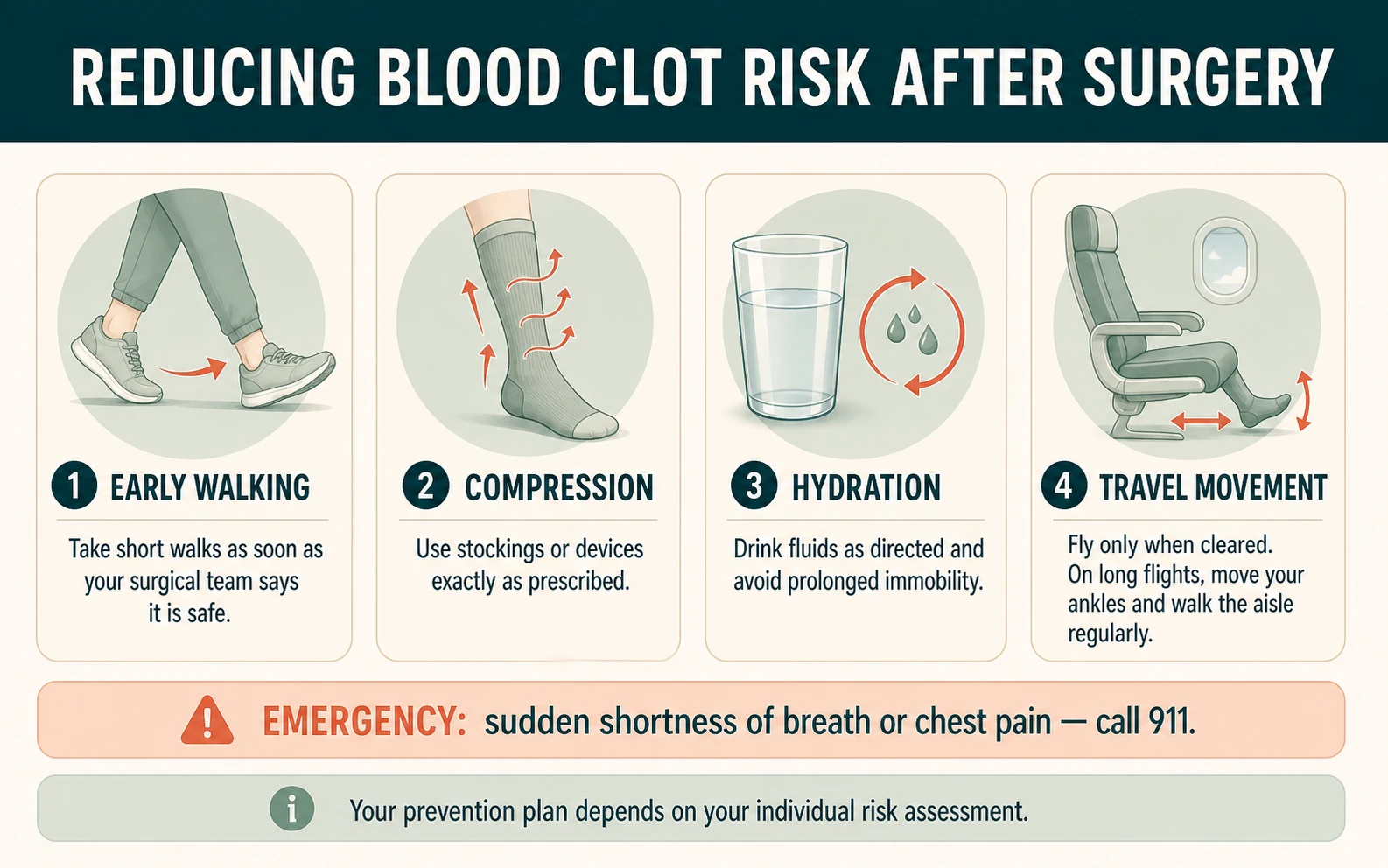
- Early ambulation — the single most important post-op prevention measure. Short walks (even to the bathroom and back) within hours of waking from anesthesia.
- Graduated compression stockings — worn for 2-4 weeks after surgery. They reduce leg swelling and promote venous return.
- Chemical prophylaxis (blood thinners) — for moderate-to-high risk patients. Options include:
- Low-molecular-weight heparin (enoxaparin/Lovenox) — injectable, typically once daily for 7-14 days
- Unfractionated heparin — less common in outpatient setting
- Hydration — drinking adequate water helps maintain blood fluidity
- Ankle pumps and calf exercises — when not walking, regularly flex and extend your ankles to activate calf muscles
- Avoid prolonged sitting or standing — alternate between resting and short walks
Warning Signs of DVT (Blood Clot in Leg)
Seek medical attention if you notice:
- Swelling in one leg (not both equally) — especially calf or thigh
- Pain or tenderness in the calf that feels like a deep cramp, especially when walking or flexing the foot upward
- Warmth in one leg compared to the other
- Redness or discoloration (often reddish-blue) in one leg
- A hard, cord-like feeling along a vein
Important: Some DVTs have no symptoms at all. This is why prevention matters even when you feel fine.
Warning Signs of PE (Blood Clot in Lungs) — EMERGENCY
Call 911 / go to ER immediately if you experience:
- Sudden shortness of breath — difficulty breathing that comes on quickly
- Chest pain — especially sharp pain that worsens with deep breathing (pleuritic)
- Rapid heart rate — feeling your heart racing unexpectedly
- Coughing up blood (hemoptysis)
- Feeling lightheaded or faint
- Sudden anxiety combined with shortness of breath
Do not wait to "see if it gets better." PE can be fatal within hours. Early treatment (anticoagulation, and in severe cases, thrombolysis or surgical intervention) is life-saving.
For a complete list of post-surgical warning signs, see: Warning Signs After Surgery.
The Travel Factor
If you're traveling for surgery (medical tourism), additional VTE considerations include:
- Pre-surgery flights — long-haul flights cause mild dehydration and immobility. Arrive at least 1-2 days before surgery to rehydrate and move around.
- Post-surgery flights — the highest-risk period. Most surgeons recommend waiting at least 7-10 days before flying. On the flight: wear compression stockings, walk the aisle every hour, stay hydrated, consider a prophylactic blood thinner injection before the flight (discuss with your surgeon).
- Economy class — cramped seating restricts leg movement. Consider an aisle seat or upgraded legroom for the return flight.
When VTE Risk Is Highest
The danger window is highest in the first 7-14 days after surgery, with peak incidence around days 3-7. However, VTE can occur up to 6-8 weeks post-operatively. Stay vigilant for symptoms throughout your entire recovery period.
Frequently Asked Questions
How common are blood clots after a mommy makeover?
For a standard mommy makeover (3.5-5 hours) in a patient without additional risk factors, VTE occurs in approximately 0.3-0.8% of cases (roughly 1 in 125-330 patients). Risk increases with longer procedures, higher BMI, use of oral contraceptives, and other personal risk factors. Proper prevention protocols significantly reduce these rates.
Should I stop birth control before surgery?
Yes. Estrogen-containing contraceptives (combined pills, patches, and rings) increase VTE risk 3-5 fold. Most surgeons recommend stopping 4-6 weeks before surgery to allow clotting factors to normalize. Progestin-only methods (mini-pill, hormonal IUD, implant) do not carry the same risk and generally don't need to be stopped. Discuss alternative contraception with your doctor during this period.
Will blood thinners make me bleed more during surgery?
Post-operative blood thinners (like enoxaparin) are typically started 6-12 hours after surgery — not before or during. When properly timed, studies show they significantly reduce VTE risk without meaningfully increasing surgical bleeding or hematoma rates. Your surgeon balances these risks based on your individual Caprini score.
How soon should I walk after surgery?
As soon as safely possible — ideally within hours of waking from anesthesia. This doesn't mean marathon walks: shuffling to the bathroom, standing for a few minutes, and taking short walks in your room or hotel all help activate the calf muscle pump that moves blood out of your legs. Aim for short walks (5-10 minutes) every 2-3 hours during waking hours from day 1.
Can I still get a blood clot even with prevention?
Yes, but it's much less likely. Prevention reduces VTE risk by 60-80%2 depending on the methods used. No prevention protocol eliminates risk entirely, which is why recognizing symptoms remains important even when all precautions have been taken. If you develop signs of DVT (leg swelling, pain) or PE (chest pain, shortness of breath), seek immediate medical attention regardless of what prevention you've had.
Key Takeaways
- VTE (DVT/PE) is the #1 killer after cosmetic surgery — but it's largely preventable
- Risk is highest days 3-14 after surgery; stay vigilant for 6-8 weeks
- Stop estrogen contraceptives 4-6 weeks before surgery
- Early walking (within hours of surgery) is the single most important prevention measure
- Know the PE symptoms: sudden shortness of breath, chest pain, rapid heart rate — call 911 immediately
- Ask your surgeon about your Caprini score and whether chemical prophylaxis (blood thinners) is recommended for you
Sources
- Caprini JA. Risk assessment as a guide for the prevention of the many faces of venous thromboembolism. Am J Surg. 2010;199(1 Suppl):S3-10.
- Pannucci CJ, Dreszer G, Wachtman CF, et al. Postoperative enoxaparin prevents symptomatic venous thromboembolism in high-risk plastic surgery patients. Plast Reconstr Surg. 2011;128(5):1093-1103.
- Pannucci CJ, Bailey SH, Dreszer G, et al. Validation of the Caprini risk assessment model in plastic and reconstructive surgery patients. J Am Coll Surg. 2011;212(1):105-12.